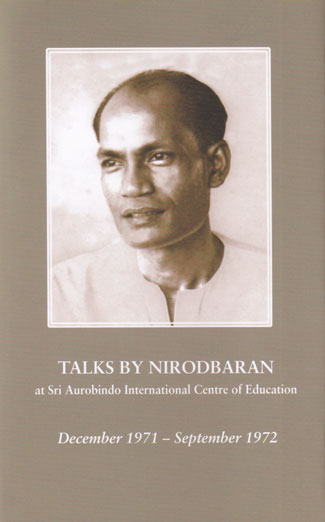
Talks by Nirodbaran (December 1971 – September 1972) Talks by Nirodbaran (December 1971 – September 1972)
— Edited by Sunayana and Maurice
Price: Rs 310
Soft Cover Pages: 236 Dimensions (in cms): 14x22
Publisher: Sri Aurobindo Ashram Publication Department, Pondicherry ISBN: 978-93-5210-345-4
About Talks by Nirodbaran (December 1971 – September 1972)
In this fourth and final volume of the talks given at the Sri Aurobindo International Centre of Education from 22 December 1971 until their end in September 1972, Nirodbaran continues to share his reminiscences about Sri Aurobindo. He also invited some senior sadhaks to speak to the students: Pranab Kumar Bhattacharya, Vasudha Shah, Kireet Joshi, Arindam Basu, Manoj Das Gupta, and Manoj Das. Nirodbaran and the guest speakers talked on various topics, among them: the meaning of the terms Avatar and tapasya, how to feel the presence of Sri Aurobindo even though he is not physically present, Sri Aurobindo’s parents and his childhood, Nishikanto as a poet, the way Darshans were observed in the early years, events that happened in the days before the Mother left her body, and Sri Aurobindo’s prediction about the advent of the superman.
REVIEW
Talks by Nirodbaran at Sri Aurobindo International Centre of Education: December 1971– September 1972 is the fourth and final volume presenting talks by Nirodbaran, one of Sri Aurobindo’s personal attendants, to the children of the Ashram School. In all, there were a hundred and fifty of them, spread out from 1969 to 1972. In addition, Nirodbaran invited some of his fellow sadhaks to speak on topics such as the daily life of the Ashram in 1927, the extraordinary place given to Sri Aurobindo by the Indian press around the time he was active in politics, the goings-on in the British House of Commons about the last warrant issued against him, the Supermind as a necessity to solve the problems faced by humanity, and life in the Ashram in the 1940s. This volume contains these talks, as well as six others given between 1973 and 1978, dealing with the Mother’s passing, describing life in the pre-ashram community during the 1920s, and explaining the Integral Yoga to children, showing them how to take it up at their level.
The Ashram School begins its session on December 16, and the talks in this volume are the ones given during the 1971–72 session. While the talks are presented chronologically it must be noted that Nirod spoke on alternate Wednesdays to an older and a younger group.
Nirod plunges straight to the heart of his subject: Sri Aurobindo. He engages his audience with warmth and simplicity, answering his own question “where is he and what is he”:
“That’s what Sri Aurobindo is — he is the Divine, he gives us force, strength, he gives us inspiration, he sustains us, he leads us to our true goal. And if we can call him, we can have a talk with him, we can eat with him, we can drink with him, we can do everything with him if we love him.”
For all his lighthearted cheer, he clearly treats his young charges as apprentice-seekers and offers them spontaneous leg-ups aplenty; when they run across the word tapasyā in a quotation he says: “…tapasyā would be, for you children, to think of him as much as you can, as long as you can, whenever you can.” Speaking of self-giving, he asks them, “But how can you give yourselves? In your play, studies, work, food — everything you do, do it for the sake of the Mother and Sri Aurobindo, without waiting for any reward in return.” His explanation of the word occultist is a good example of how he expands their awareness of their own special context along with their vocabulary:
“An occultist is one who has the knowledge of things which are hidden, mysterious. For example, if I’m able to tell your thoughts and feelings, I’m an occultist. I shall relate an anecdote of the Mother’s occult power — a simple example. Earlier we used to go to the Mother in the morning, for blessings, at the head of the staircase. One day a young man was tempted to test the Mother and said, “Mother, can you tell me what I have done today?” She began to narrate all that he had done — and when she came to his weak point, he said, “Mother, Mother, it’s all right!”, because there were others standing there!”
For the younger group, Nirod decides to take up the story of Sri Aurobindo’s life — his family background, his birth, childhood, his youth in England. With his characteristic frankness he discusses not only bright and happy things but also touches on the sad and the serious, such as his mother Swarnalata’s derangement. Within the scope of these fortnightly 40-minute sessions, he presents, in addition to the general course of Sri Aurobindo’s life, some unusual and often thought-provoking information, such as Swarnalata’s horsemanship, her running the household alone in England after her husband returned to India, and Rajnarayan Bose’s exhortation to K.D. Ghose, Sri Aurobindo’s father, as he was first leaving for England to “come back as an Indian”. He surprises us equally with his report of the Mother’s brother Matteo Alfassa’s conquest of anger, and his explanation of why so little of the poetry written by Sri Aurobindo during the England period survived — he tore it up. We also learn that before Sri Aurobindo started following the progress of his disciples through correspondence, he was kept informed of the same by the Mother, who visited each one daily while in trance. The children must have been thrilled to learn that Sri Aurobindo wrote letters in numeric code to Motilal Roy, as are we when he reads out an extract from a letter to the same Roy — a rare summary of his own mission by Sri Aurobindo:
“I may say briefly that I have been given a religious and philosophical mission to explain the Vedas and Vedanta (Upanishads) in the ancient sense which I have recovered by actual experience in yoga and to popularise the new system of Yoga (new in arrangement and object) which has been revealed to me and which as I progress, I’m imparting to the young men staying with me and to others in Pondicherry. I have to spread certain ideas about God and life by literary work, speech and practices, to try to bring about certain social changes and finally, to do a certain work for my country in particular, as soon as the means are put in my hands.”
For the older group, Nirod bases himself on his correspondence with Sri Aurobindo, beginning with the story of how Nirod became a poet. After a difficult period of churning out uninteresting work, “one day poetry suddenly burst forth — as though a stone blocking the mouth of a hidden spring had been removed.” This was only possible because he had followed Sri Aurobindo’s instruction and “was able to keep the mind silent — and whatever came up I transcribed — I became a medium.” Interestingly, the silence was only in relation to poetry and did not extend to other areas. Other themes shown through the correspondence include how to deal with depression, medical cases treated from a spiritual perspective, Sri Aurobindo debunking the theory that he had achieved immortality and explaining how far he had mitigated and controlled the ills of the body, the stabilisation of spiritual experience, and the arts as a preparation of the consciousness and how they can become part of one’s sadhana.
Apart from the correspondence, Nirod shares very special perspectives of Sri Aurobindo, such as the one revealed in an article by Upen Banerji, which Nirod has translated from the Bengali. Banerji knew Sri Aurobindo from 1906 and, as part of the Bande Mataram team, had the opportunity of seeing him at work at the height of his political career. While speaking of the changes that came upon Sri Aurobindo after meeting Lele, Upen wrote: “Salt and curry were a taboo. No dal and curry with rice. Rice, milk and fruits were the only food... He passed [an] order in the Bande Mataram office that nobody was to be abused in the paper… He began preaching that the revolution could only proceed by the awakening of a religious feeling in the country.” Banerji’s observation, “I don’t remember having seen any other person with such an extraordinary power of concentration as Aurobindo-babu”, prompts Nirod to share his own experience:
“We have seen this often. Sri Aurobindo used to sit on his bed writing The Life Divine, at his wheel-table. He had three pens, two pencils and some sheets of white paper, a side cushion with some handkerchieves. He was engrossed, absorbed in his work. As he had his first meal very late — sometimes as late as 2 o’clock — the Mother used to come with a glass of coconut water or plain water, in the middle. She would come very gently — gliding as it were — near his bed and stand there and watch him. No cognizance from Sri Aurobindo’s part, he was writing, writing, writing, while the other was waiting and smiling. A very beautiful sight indeed. Suddenly, perhaps the Mother often sent a vibration, he looked up exclaiming “Ah!” [and] stretching out his hand, took the glass from her hand and sipped the water slowly. Then there is the famous instance when there was a storm raging outside, and he knew nothing of it!”
The four-volume set of talks is a treasure of information and inspiration regarding the Masters, the Method and the community. It is felicitous to have brought out the final volume on the occasion of the centenary of the Ashram. Our gratitude to Sunayana Panda and Maurice Shukla for having brought these talks to the light of day, to Kokila Pandya for her labours with the transcription, and thrice hail to Sudha Umachigi who conceived the project, was responsible for the transcription, and released it from her archives at this opportune moment.
— Sunam Mukherjee
Sunam reads proof at the Sri Aurobindo Ashram Press.