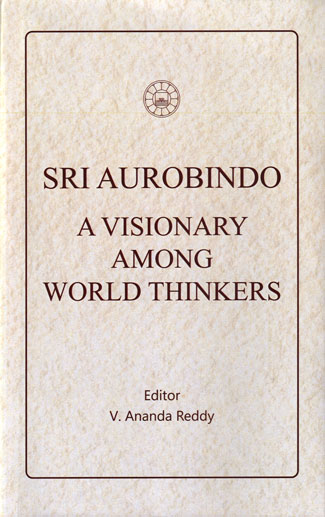
Comparative Studies in Select Concepts from Sri Aurobindo and World Thinkers
— Essays by Various Authors, Editor: Dr V. Ananda Reddy
Price: Rs 750
Soft Cover Pages: 387 Dimensions (in cms): 16x24
Publisher: Sri Aurobindo Centre for Advanced Research Trust, Pondicherry ISBN: 978-93-85391-41-5
About Sri Aurobindo: A Visionary Among World Thinkers
Contemporary scholars compare Sri Aurobindo’s perspective on a range of concepts and ideas with noted philosophical and contemplative thinkers from both India and the West. The leadoff essay by Nolini Kanta Gupta sets the high tone of this collection by setting out the ideal of Sri Aurobindo “to divinise the human, immortalise the mortal, spiritualise the material”. Five essays compare Sri Aurobindo’s ideas with other Indian thinkers on subjects such as spiritual awakening and enlightenment and interpretations of Advaita. The remaining essays examine comparisons with Western philosophers including Heraclitus, Gebser, Hegel, and Chalmers; psychologists Freud and Csikszentmihalyi; revolutionaries Marx and Gramsci; and educationists and linguists Steiner, Montessori, and Bakhtin. In the wideness and depth of these reflections one recognises Sri Aurobindo’s power to reveal, “to the eye of vision and the heart of faith”, the promise of this highest ideal for our future.
REVIEW
To commemorate the 150th birth anniversary of Sri Aurobindo (1872–1950) V. Ananda Reddy has brought together an eclectic group of scholars for this volume of comparative essays. The book is structured into two sections, one dealing with Indian and one with Western thinkers, ranging from spiritual figures and philosophers to revolutionaries and psychologists to educationists and linguists.
After an introductory reprint of “The Ideal of Sri Aurobindo” from the Collected Works of the renowned disciple Nolini Kanta Gupta, the first chapter, by Dr Prema Nandakumar, deals with the Tamil “writer, poet and activist” Subramania Bharati. It leaves one wondering what additional insightful writing and commentary Bharati might have produced if he had stayed with Sri Aurobindo in Pondicherry after their initial discussions of scripture and conversations while walking on the beach shortly after Sri Aurobindo arrived in Pondicherry. Next, Dominique Schmidt discusses Jiddu Krishnamurti’s “observer” as it related to Sri Aurobindo’s Purusha as well as each of their respective perspectives on practical and visionary aspects of spirituality. Dr Pariksith Singh elucidates the concept of Advaita from both the great bhakta Ramanujacharya’s and the Integral Yoga’s perspectives. Then we are taken through major concepts of the intricate philosophy of aesthetics credited to Acharya Abhinavagupta by Dr Shruti Bidwaiker – from pratibha or genius, to dhvani or suggestion, to Poetic Vision or drishti – and the different inspirational sources of, forms of expression for and ways of experiencing poetry from the Acharya’s and Sri Aurobindo’s viewpoints. Finally, to conclude the section on comparative studies on Indian thinkers, Dr Reddy goes through arguments for different interpretations of Advaita as illusionist or realistic in relation to Adi Shankaracharya and Sri Aurobindo, taking us through experiential, philosophical and logical arguments for Brahman as perceiver, perceived, and double, dual or individual consciousness, as well as relating to imagination, illusion and suffering.
Richard Hartz takes us on a journey back in time to the ancient Greeks with the first chapter of section two on Western thinkers as he looks at Heraclitus, whom he sees as representing a transition from the symbolic and mystical to the more rational phases in Western culture, paralleling developments in the East with a focus on symbols, seemingly obscure riddles, the elements, especially fire, the contemplation of questions of oneness and multiplicity, war, reason and finally “The Kingdom of the Child”, which Sri Aurobindo interprets as follows:
Force by itself can only produce a balance of forces, the strife that is justice; in that strife there takes place a constant exchange and, once this need of exchange is seen, there arises the possibility of modifying and replacing war by reason as the determinant principle of the exchange.… From exchange we can rise to the highest possible idea of interchange, a mutual dependency of self-giving as the hidden secret of life; from that can grow the power of Love replacing strife and exceeding the cold balance of reason. There is the gate of the divine ecstasy. Heraclitus could not see it, and yet his one saying about the kingdom of the child touches, almost reaches the heart of the secret. (CWSA 13: 253)
The Swiss philosopher Jean Gebser (1905–1973), explored in this essay by Dr Vladimir Yatsenko, developed evolving structures of collective consciousness he called the Archaic, Magic, Mythical, Mental and Integral. Dr Yatsenko relates these both to the social psychology of The Human Cycle and the Vedic Yugas, concluding the chapter with the last Hymn of the Rig Veda as a representation of the Integral structure of collective consciousness:
Saṁ gacchadhvam, come together (magic structure), saṁ vadadhvam, speak together (mythical structure), saṁ vo manāṁsi jānatām, may your thoughts know together (mental structure), devā bhāgaṁ yathā pūrve sañjānānā upāsate, as the first gods who sat together agreeing on the portion of the work/sacrifice they should take on in the creation.
Dr Martha Orton explores Pierre Teilhard de Chardin’s (1881–1955) ideas of oneness and the omnipresent divine, the evolution of biology and consciousness, as well as the pursuit of knowledge and the value of offering in humanity’s progress towards union with the Divine. While Sri Aurobindo introduced the vision of the Supramental, Teilhard envisioned what he called the Ultra-Human evolving towards spiritual transformation: “The only air which Reflection can breathe must, of vital necessity, be that of a psychically and physically convergent Universe. There must be some peak, some revelation, some vivifying transformation at the end of the journey.” (from Chapter 21 of The Future of Mankind by Pierre Teilhard de Chardin)
In the chapter on the German philosopher G. W. F. Hegel (1770–1831) Prof. Debidatta Aurobinda Mahapatra points out that the total obedience to the state as the ultimate authority advocated by Hegel played a role in later justifications for committing atrocities and genocide in Nazi Germany. He contrasts Hegel’s mental construct of the state and its artificial organisation with Sri Aurobindo’s Nation Soul, which will express itself in free societies that consciously and harmoniously grow towards higher forms of union. In the last chapter on Western philosophers Prof. Sreekala Nair examines the Australian philosopher of consciousness David Chalmers’ (1966–) arguments for solving “the hard problem of consciousness” or the question of how the brain generates coherent subjective experiences typical for humans. Of course, as she quotes him, Sri Aurobindo approached this riddle of the origin of consciousness from the opposite end: “But such an explanation…becomes absurd if we try to explain by it thought and will, the imagination of the poet, the attention of the scientist, the reasoning of the philosopher.… no mere mechanism of grey stuff of brain can explain these things.…” (CWSA 12: 275)
Next, Dr Soumitra Basu takes us on a trip into the sub- and inconscient, contrasting Sigmund Freud’s (1856–1939) psychoanalytical terminology and framework with that of Integral Yoga Psychology and its subliminal, supraconscient and transformative processes. Larry Seidlitz, PhD, continues this line of inquiry by relating instructions and experiences of Karma Yoga to the psychological research into the concept of flow by the Hungarian-American Mihaly Csikszentmihalyi (pronounced “me high, cheek sent me high”, 1934–2021), finding similarities and differences as well as complementary aspects in the two approaches to consciousness and work.
The section on revolutionaries kicks off with a bang in a first paragraph packed with sentences such as “Man has enjoyed himself too little and wasted a large part of the treasure trove of life on frills, foibles, follies, on superficial conflicts, on suicidal swagger and puerile megalomania” in a chapter on Sri Aurobindo and Karl Marx (1818–1883) by Dr Charan Singh Kedarkhandi, who draws parallels between their visions of ideal future societies and the radical inner and outer changes they respectively proposed to realise these ideals. Dr Madhumita Dutta introduces us to another Marxist philosopher, the Italian Antonio Gramsci (1891–1937), who, she finds, shares ideas with Sri Aurobindo’s thought on the role of culture, education – especially for those with a lower socio-economic status –, and especially freedom and the possibility to discover and pursue one’s inner higher ideals:
Freedom is not utopia, because it is a basic aspiration; the whole history of mankind consists of struggles and efforts to create social institutions capable of ensuring a maximum of freedom. (The Antonio Gramsci Reader: Selected Writings, 2014, 51)
To know oneself means to be oneself, to be master of oneself, to distinguish oneself, to free oneself from a state of chaos, to exist as an element of order… but of one’s own order and one’s own discipline in striving for an ideal. (Ibid., 59)
Dr Dutta also reflects on the challenges inherent in comparative studies of this kind, writing that “of course, here I am being neither judgemental or exhaustive in my study, which is a bit constrained, nor is it my intention to compare the merits of one to the advantage of the other”, which can be seen as an exemplary attitude towards comparative scholarly work.
In the final part of the book on educationists and linguists, Dr Chhalamayi Reddy reviews the Austrian Rudolf Steiner’s (1861–1925) approach to education and finds that in comparison to Integral Education Steiner “came up with similar principles underlying the development of a child which he explains in detail in his presentation of Anthroposophy or Spiritual Science”. This seems even more true for Maria Montessori (1870–1952), one of the first female physicians of Italy and an educational reformer. Dr Beloo Mehra assesses her “Montessori Method” to be “a truly progressive education” due to “its close alignment with Integral Education as envisioned by Sri Aurobindo and the Mother”, especially when it comes to the perception of the child, its capacity for silence and self-discovery, the role of freedom in ideal learning environments and the teacher’s role to model and facilitate inner growth. The collection of studies is concluded by Prof. Lakshmi Bandlamudi’s exploration of the tragic life story and fragmentary literary works on language and literature produced by a “giant in literary theory”, the Russian Mikhail Bakhtin (1895–1957) who lived “under the dictatorship of Stalin”. She explores Bakhtin’s philosophical, linguistic and aesthetic concepts such as Dialogue, Answerability and more in comparison to Sri Aurobindo’s works. She finds that both “Sri Aurobindo and Mikhail Bakhtin had very little appetite for ugly polemics and angry rhetoric, as they rarely are effective corrective measures for combating falsehood” and that although “almost all the members of his [Bakhtin’s] study circle were shot to death” both their writings are a testament to the power of inner realities and their literary expressions, concluding that “what mattered to Sri Aurobindo and Mikhail Bakhtin was Interior Truth and Internal Freedom.”
In reading this book one can be reminded of a conversation between the Mother and a disciple in which she states that
a book […] to write a kind of dialogue to introduce Sri Aurobindo’s ideas—it’s a good idea—like the conversations in Les Hommes de Bonne Volonté by Jules Romain. He wants to do it, and I told him it was an excellent idea. And not only one type—he should take all types of people who for the moment are closed to this vision of life, from the Catholic, the fervent believer, right to the utmost materialist, men of science, etc. It could be very interesting.
While Romain’s epic novel wasn’t an academic scholarly work like the book reviewed here, similarly to his literary panorama of 20th century collective life presented through the lenses of different archetypal fictional characters representative of attitudes and beliefs of their time, “A Visionary” achieves a kind of intellectual dialogue between Sri Aurobindo and “World Thinkers” in a way that the Mother might have likewise given her blessings to.
—Matthias Pommerening
Matthias, a psychologist, is a frequent contributor of book reviews for Recent Publication.