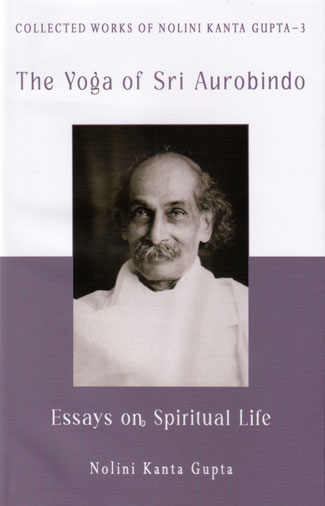
The Yoga of Sri Aurobindo: Essays on Spiritual Life
(Collected Works of Nolini Kanta Gupta: Volume 3)
— Nolini Kanta Gupta
Price: Rs 510
Soft Cover Pages: 439 Dimensions (in cms): 14x22
Publisher: Sri Aurobindo International Centre of Education, Pondicherry ISBN: 978-93-5210-338-6
About The Yoga of Sri Aurobindo: Essays on Spiritual Life
This third volume of the revised and enlarged edition of the Collected Works of Nolini Kanta Gupta comprises short essays that deal with different aspects of Sri Aurobindo’s philosophy and Yoga. Most were first published in The Advent or Mother India, two journals brought out by the Ashram, and made up the first edition of these Collected Works. At the end of the volume, there is an appendix with seven writings or talks that did not appear in the first edition of the Collected Works, a life sketch of Nolini Kanta Gupta, and a general note on the second edition of his Collected Works. The seven writings and talks included in the Appendix were originally published in The Advent or Mother India between 1951 and 1971, with titles such as “The Master Is Always Here”, “The New Body”, and “1971—A Sweet Year”.
REVIEW
The second edition of the third volume of the Collected Works of Nolini Kanta Gupta consists of about a hundred essays written between 1939 and 1972 including seven essays that hadn’t been included in the first edition, presented in seven parts plus an Appendix across 440 pages.
Nolini Kanta Gupta’s writings are not just any secondary literature on Sri Aurobindo and the Mother’s life, work, vision or writings. It might be the closest written material in style and substance to Sri Aurobindo’s original works, as it exhibits attributes of vastness and detail in integral vision, complementing and harmonising perspectives and the incorporation of various fields of study and knowledge rarely encountered. In their own right, while of course being inspired, referencing and touching upon many of the same themes elucidated in Sri Aurobindo’s writings, these essays strike the reader not only as expressions of intellectual understanding of the primary literature, but are also impressive in their scope and depth. The writing also gives a sense of the genuine spiritual experience and development of the author, possibly unparalleled by any other writer on these subject matters, except of course the ones who guided and provided the basis for Nolini Kanta Gupta’s inner life and work.
With a background in psychology, I sympathise with an approach to spirituality that values the empirical aspect of yoga as a methodical practice to gain ever more objective knowledge of consciousness, energies and the nature of reality. Nolini Kanta Gupta’s writings demonstrate that, on the basis of Sri Aurobindo’s vision, mathematics (“Two Equations”), the symbolic and experiential truths of ancient scripture, poetry (“The Hero and the Nymph”) and literature (“The Story of Dr. Faustus Retold”) can come together in life as an integral spiritual practice and outlook on humanity, cosmos and their eventual destiny (“Lines of the Descent of Consciousness”). Nolini Kanta Gupta references subjects such as quantum physics (“Cosmonautics”), areas of the brain and nervous system (“The Mounting Fire”), or religious, historical and mythological figures, philosophers and occult rites (“The Feast of Lights”, “The New Body”). He does so in the context not only of the Integral Yoga, the vision of Sri Aurobindo and the Mother, but of our everyday lives with their challenges of human suffering, existential questioning, doubt of ourselves, the divine and struggle with our apparent fate. These essays can be deeply moving and inspiring.
The short essays ranging from half of a page to a few pages lend themselves to slow contemplative reading. It’s both impressive and somewhat saddening how timely some of Nolini Kanta Gupta’s reflections from over half a century ago still seem today, as one piece of writing included in the volume named “The Situation of Today” exemplifies. With wars, conflicts and crises of all kinds within and between individuals and collectives to seemingly still mount, his writings on psychological and physical pain from the perspective of the Integral Yoga in “Mater Dolorosa”, “Origin and Nature of Suffering”, “The Tragic Spirit in Nature”, “The Sorrows of God” and “The World Tragedy” feel poignantly relevant. These more philosophical explorations of the subject matter are complemented by practical instructions on how to deal with the limitations and weaknesses of our ignorant human nature in daily life.
As he describes, we have to become conscious, understand the nature of being, its constitution in our individuality and the possibilities of changing it (“Consciousness”, “Consciousness as Energy”, “Consciousness as Freedom”, “Ego”):
To renounce is a greater delight than to enjoy. To give is a greater joy than to take. To love is a greater ravishment than to be loved. ... It is the Divine that knows the Divine through the Divine. It is the Divine that dynamises the Divine through the Divine. It is the Divine that enjoys, loves the Divine through the Divine. (“Ego”, p. 223)
He further explains how this involves a thorough integral development of ourselves (“Education as the Growth of Consciousness”, “Education is Organisation”, “Mind and the Mental World”), the cultivation of necessary qualities and attitudes (“Sincerity”, “True Humility”, “On Discipline”) and the processes to undergo (“Effort and Grace”, “Go Through”, “Beyond Love and Hate”):
“True humility has an unostentatious quietness, as it has a living and secret contact with the divine consciousness.” (“True Humility”, p. 109)
These inner practices, their principles and goals, are contrasted with those of other traditions that aim not at transformation but escape from earthly reality (“Here or Otherwhere” and “The Golden Lifeline”), with the Integral Yoga presented as the consummation of spirituality, otherwise relegated beyond the world, now here in physical matter. (“Transfiguration”, p. 188):
“The real solution is not to cut away or wipe off the shadow but instead of an obscure formulation, to make of it a luminous radiant image. The world is not abolished or eclipsed by the Sun but is made luminous, in every particle a radiant and glorious body.”
On these topics the author draws on his extensive knowledge of various spiritual traditions, particularly the Indic ones (“The Labours of the Gods”, “Sri Aurobindo’s Gita”, “Arjuna or the Ideal Disciple”, “Beyond Vedanta”) and introduces relevant Sanskrit terms by elegantly weaving them into the text with easy-to-understand explanations of their meaning. Finally, Nolini Kanta Gupta puts before us the vision of a humanity (“The Divine Man”), mind (“The Golden Bridge”), and body (“Towards the Immortal Body”) transformed by the supramental (“Sri Aurobindo’s Message”):
It is the world of Idea-Force which Sri Aurobindo has named Supermind: it is beyond the mind, even the highest mind: it is the typal concentration of the Supreme Consciousness. It is the fulcrum for the Supreme Consciousness to create and express a new formulation of the Truth in the world of matter.… It links the two ends in a supreme and miraculous synthesis negating neither, giving the full value to each, for the two are united, concentrated in its substance. Thus is found the golden bridge uniting earth and heaven. (“The Golden Bridge”, p. 308)
— Matthias Pommerening
Matthias, a psychologist, is a frequent contributor of book reviews for Recent Publications.