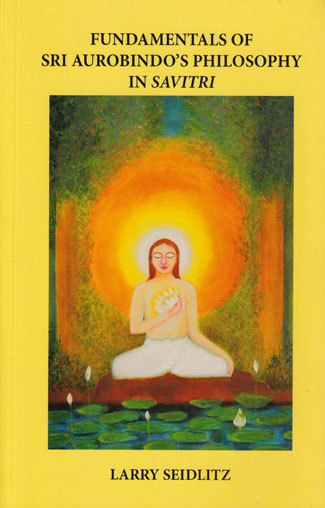
About Fundamentals of Sri Aurobindo's Philosophy in Savitri
The very title of this book, Fundamentals of Sri Aurobindo’s Philosophy in Savitri, promises a study of how the substance of its high thought is at the heart of its innovative poetic style, its revelatory mantric poetry. The first chapter introduces how these two aspects of the poem unite in some of its most visionary and incandescent passages. Subsequent chapters partner timely prose passages from his major works with selections from Savitri on such principles as the duality of Ishwara-Shakti, the Divine Mother, the psychic being, fate, karma and free will, the occult worlds, involution and evolution, the realisation of the spiritual Self, and the Supermind and its transformation of life on earth into a life divine. The author’s commentaries on the selected passages from Savitri and their corresponding grounding in excerpts from his prose works weld language and import in a nuanced understanding of Sri Aurobindo’s teaching.
REVIEW
If ever one despairs of getting a handle on Aurobindonian thought as expounded by Sri Aurobindo and the Mother in their numerous writings, there is hope in this slim volume by Dr Larry Seidlitz deceptively titled Fundamentals of Sri Aurobindo’s Philosophy inSavitri. Deceptively, because the text of his book draws heavily on the prose works of Sri Aurobindo to describe in detail all that is dealt with in the epic Savitri, which, as the author notes, encompasses every facet of Aurobindonian thought in mantric poetry. In lucid and transparent academic prose, the author divides the book into twelve chapters that one by one deal with some of the major components of Sri Aurobindo’s experiences and his philosophy, each one drawing on Sri Aurobindo’s prose writings to explicate an idea that occurs in not-easily-accessible poetic form in Savitri.
As a glance at the table of contents will indicate, the book deals with what are commonly regarded as debating points and fundamental issues in the oeuvre of Sri Aurobindo’s thought. Further perusal of each chapter will demonstrate the care the author takes in comprehensively presenting each subject as it arises in Savitri based on the prose writings of Sri Aurobindo. The author begins each chapter with a presentation of what he is going to say in that chapter and sticks close to the original work of Sri Aurobindo, inserting his illuminating comments only where he judges them required.
As an example, we may take the chapter titled ‘The Divine Mother’ (Chapter 4). He begins simply: “In this chapter we will see Sri Aurobindo’s explanations and descriptions of the Divine Mother in both his prose writings and in Savitri.” He continues with detailed explorations on the topic, citing generous quotations from both Savitri and Sri Aurobindo’s prose writings, such as selections from his short work The Mother, which expound on “the Divine Mother in her Transcendent, Universal, and Individual aspects and her relation to us and our world”. The author points out that in these lines Sri Aurobindo is describing her universal aspect, the Mahashakti:
Above them all she stands supporting all, The sole omnipotent Goddess ever-veiled Of whom the world is the inscrutable mask; The ages are the footfalls of her tread, Their happenings the figure of her thoughts, And all creation is her endless act. (CWSA 33: 295)
Other chapters focus on such principles and concepts as the duality of Ishwara-Shakti, the psychic being, the complex questions of fate, karma, and free will, the realisation of the spiritual Self, and the nature of the Supermind and its descent into earthly life. This topic-wise approach to Sri Aurobindo’s thought is most helpful both to those who are new to the concepts here and to those to whom they are familiar. To the initiated the book lends structure to their easy familiarity with Sri Aurobindo’s work. To new readers it provides coherence, linking major themes in Savitri to their foundations in his prose writings. One arrives at the end of the book with a satisfying starting point for further exploration.
The first chapter, titled ‘Introduction: The Marvel of Savitri’, serves the dual function of introducing the book as well as the epic itself. In this chapter too, the author writes as he writes the rest of the chapters, letting Sri Aurobindo speak on the epic in his own words and interjecting only wherever he feels clarity is called for.
We may close with a few words on this important introductory chapter. The author delineates three dominant themes in Savitri: the struggle, suffering, and evil that confront us in life; the persistent growth and evolution of life despite this opposition; and the sheer delight, love, and power of the Divine that supports this evolution. He then chooses sample passages from Savitri on the emergence of life in matter, the role and limitations of reason, the presence and guidance of the Divine, the reason for pain, the dark powers, the Avatar’s sacrifice for humanity, the World-Soul, the cosmic consciousness, and the prophecy of a divine life on earth. He introduces each passage with a sentence or two as a sort of framework for understanding the poetry while encouraging the reader to pay close attention to the form and beauty of each line. Savitri was a work that Sri Aurobindo fashioned over many years of his life, which he wrote and rewrote as he progressed in the practice of his yoga. Each line had to be complete, the perfect marriage of thought and form. Although representative, this sampling of passages is characteristic of the breadth and profundity of the entire poem.
To get a sense of how accessible Dr Seidlitz makes Savitri, we may reproduce his quote from the poem that speaks to Sri Aurobindo and the Mother’s principal mission, to open the earth-consciousness to the supramental light and power that will transform life on earth. Under the theme titled ‘The Prophecy of the Life Divine on Earth’ the author quotes a long passage from Savitri that opens with these memorable lines:
O Sun-Word, thou shalt raise the earth-soul to Light And bring down God into the lives of men; Earth shall be my work-chamber and my house, My garden of life to plant a seed divine. When all thy work in human time is done The mind of earth shall be a home of light, The life of earth a tree growing towards heaven, The body of earth a tabernacle of God. (CWSA 34: 699)
Dr Seidlitz’s book admirably unites the revelatory power of Savitri’s poetry with the philosophical explications in his prose writings. This is a go-to book for anyone who wishes to contemplate some of the major themes in Sri Aurobindo’s vision of life and its future evolution by an author with a long association with his writings.
—Sivakumar Elambooranan
Sivakumar was an academic philosopher who has now turned to writing. After living abroad for some years, he has settled in his native Pondicherry, where he is associated with the Sri Aurobindo Ashram.