

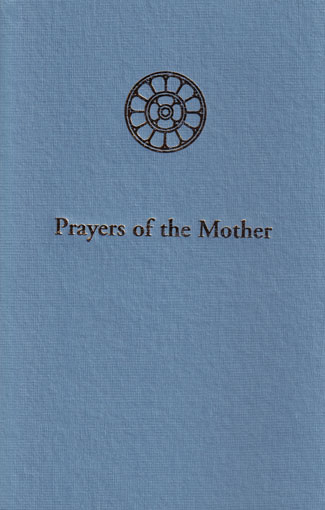
Prayers of the Mother
123 Prayers Translated by Sri Aurobindo or Translated by Disciples and Revised by Him
— The Mother
| Price: Rs 170 Pages: 102 Dimensions (in cms): 14x22 ISBN: 978-93-5210-216-7 | Soft Cover | |
| Publisher: Sri Aurobindo Ashram Publication Department, Pondicherry | ||
 | ||

|
Your cart is empty... |
About Prayers of the Mother
The 123 prayers in this book, about two-fifths of the complete collection, constitute all of the known translations of the Mother’s Prayers and Meditations in which Sri Aurobindo had a hand. Originally written in French, Sri Aurobindo directly translated 24 of these prayers in whole or in part. The remaining 99 were translated by disciples and then meticulously revised by him. In revising these prayers, he not only corrected errors of language and grammar, but recast them with a view to style. 58 of these translations by the disciple Datta with revisions by Sri Aurobindo are being published here for the first time.
REVIEW
Prayers of the Mother contains all the known translations of the Mother’s Prayers and Meditations in which Sri Aurobindo had a hand. Sixty-one translations were first published in 1941 in a small book titled Prayers and Meditations of the Mother. Sri Aurobindo saw this book through the Press and made revisions at page-proof stage. He himself translated 24 of the prayers (in whole or in part) and revised the remaining translations made by disciples. Three more prayers were added to the book by the Mother in 1962, making 64 prayers in all.
The present book includes these 64 prayers, along with 59 prayers translated by disciples and revised by Sri Aurobindo. In revising them, he not only corrected errors of language and grammar but recast them with a view to style — all bear the impress of his literary excellence.
One of the 59 prayers, that of 28 December 1928, was first translated by Nolini Kanta Gupta. Compare his translation of the first sentence with Sri Aurobindo’s revision of it:
Nolini-da:
There is a Power no government can array; a Happiness no earthly success can procure; a Light no wisdom can possess; a Knowledge no philosophy nor science can acquire; a Bliss no satisfaction of desire can make us enjoy; a thirst for Love no human relation can allay; a Peace that is found nowhere, not even in death.
Sri Aurobindo:
There is a Power that no ruler can command; there is a Happiness that no success on earth can bring; there is a Light that no wisdom can possess; there is a Knowledge that no philosophy and no science can master; there is a Bliss of which no satisfaction of desire can give the enjoyment; there is thirst for Love that no human relation can appease; there is a Peace that one finds nowhere here, not even in death.
The disciple’s clear and fluent but prosaic translation has been transformed by the Master’s felicitous touch into an elevating literary testament.
Fifty-eight of the prayers in this book were translated by the Englishwoman Dorothy Hodgson. Known in the Ashram as Datta, she lived with the Mother in Japan and came with her to Pondicherry. Sri Aurobindo carefully revised Datta’s translations and turned them into prayers of great power and beauty. The manuscripts of these prayers have long been in the possession of the Ashram Archives, but little of their wording was incorporated in the translations appearing in 1978 in Prayers and Meditations, Volume 1 of the Collected Works of the Mother. The full texts of these 58 translations with all of Sri Aurobindo’s revisions are being published here for the first time.
Let us look at the difference between Datta’s rendering of the sentences of three prayers and Sri Aurobindo’s revision of them.
Datta:
O my sweet Master, through, by this love Thou art resplendent in all things, and the ever-increasing splendour will actively radiate over all the earth and become perceptible to all the consciousnesses.
Sri Aurobindo:
O my sweet Master, through and by this love Thou shinest in all things and that splendour of Thine ever increasing in its force, shall radiate its action over all the earth, and become perceptible to the consciousness of all. (4 June 1914)
Datta:
O dear children, sorrowful and ignorant, O thou nature, rebellious and violent, open your hearts, calm your forces; lo, there cometh the sweet all-might of love, the pure radiance of light which penetrates you.
Sri Aurobindo:
O beloved children, sorrowful and ignorant, and thou, O Nature, rebellious and violent, open your hearts, tranquillise your forces; for lo, there cometh the sweet omnipotence of love, lo, the pure radiance of the light that penetrates you.
(9 June 1914)
Datta:
The pen is mute; for the thought remains silent, but the heart aspires to Thee, O Lord, uniting Thee to our divine Mother, in a single love, a single veneration. And through Thee the whole being stretches to the Inexpressible Being, beyond Silence itself, that united to That.
Sri Aurobindo:
My pen is mute; for thought is silent, but my heart aspires to Thee, O Lord, uniting Thee to our divine Mother in one love, one veneration. And through Thee the whole being strains towards the Ineffable; beyond Being, beyond the very Silence that is united to That. (20 September 1914)
In these prayers, with just a few changes Sri Aurobindo has turned Datta’s prose translations into beautiful poetic expressions. So it is with all the prayers he revised. In an evening talk Sri Aurobindo once noted with appreciation Stephen Phillip’s observation that “the English language is like a woman who will love you only if you take liberties with her”. The same may be said of Sri Aurobindo’s translations: in crafting his superb renderings, Sri Aurobindo has taken many little liberties with the Mother’s French text; but the result is prayers of unusual elegance and elan.
For those who love the Mother’s prayers and Sri Aurobindo’s linguistic artistry, this new book will be a joy to read.
— Bob Zwicker
Bob is an editor at the Archives and Research Library of the Sri Aurobindo Ashram.
Reviewed in August 2026
