

A Captive of Her Love
Letters and Paintings of Janina Stroka
— Letters and Paintings of Janina Stroka
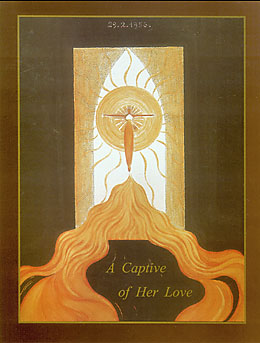
Pages: 106 Dimensions (in cms): 22x28 ISBN: 978-81-7058-520-6 | Soft Cover | |
| Publisher: Sri Aurobindo Ashram Publication Department, Pondicherry | ||
 | ||

|
Your cart is empty... |
About A Captive of Her Love
This book is a collection of letters, poems and paintings by a Polish disciple of Sri Aurobindo and the Mother.
REVIEW
This is a truly fascinating book that should interest readers of many backgrounds and persuasions. Employing a primarily epistolary mode, through the use of letters, it combines several interesting categories as well: spiritual travelogue, quest narrative, period history and East-West encounter. Above all, it bridges the gap between the falsity of public image vis a vis the reality of our private self.
Poet, painter, educator and spiritualist, Janina Stroka was born in Lyov, Poland on 18 July 1909, the younger of two daughters. Her parents were both professionals: father Jan Stroka was an engineer and mother Jadwiga Krasuka, a teacher.
With the Nazi annexation of Poland and the beginning of persecution, Janina joined an exodus of refugees and fled to Slovakia and then to other countries such as Hungary, Yugoslavia and Turkey, finally reaching Palestine. In Jerusalem, she happened to attend a lecture on Sri Aurobindo and discovered miraculously The Life Divine in a second-hand bookshop. It is then that she began her career as a painter and her real mission in life: spirituality. Initially, Janina looked after a boarding school for Arab girls in Jerusalem. In 1948, World War II over, and the rise of Zionism in Palestine for Israel, Janina, a non Jew, went back to Poland, this time to the equally oppressive and unwelcome arms of Soviet Communism. She fell ill and later, destiny brought her through a long and arduous journey to Pondicherry. It is here that she became, in her immortal words "a captive of the Mother's Love". From her arrival on 17 December 1957 till her untimely passing on 17 July 1964, her 55th birth anniversary, Janina was to remain under the care of the Mother's everlasting love. She took charge of the Nursing Home for surgical cases. Yet, her personality was versatile: she took keen interest in nursing and painting, was involved in educational experiments and wrote poems in English and French.
Janina's account of her life in Pondicherry in this book is divided into three parts. The main part of the text consists of extracts from letters written to a Dutch friend with whom Janina lived first in Palestine and later in Germany, from December 1957 to June 1958. The letters in the next section were written between 1960 and 1963 to a young Bengali, a writer and social worker. Next, the book contains selected poems and paintings by Janina and concludes with a comment by the Mother on Janina's passing. And what a profound observation it is!
All of these provide an invaluable glimpse into Janina's inner life in the Ashram, no less than her observation of the details of the seemingly trivial but no less significant aspects of the day to day life in the Ashram and Pondicherry during the late fifties and early sixties. We find, for instance, a perceptive description of meal-time atmosphere in the Dining Room. Those who habitually crib against the Dining Room food would do well to see Janina's sense of reverence towards this food ("We always get two bananas and a wonderful yoghurt, just a dream!"). She talks memorably of a number of events and impressions of the supramental force spread over Pondicherry, vis a vis the ubiquitous presence of the town's dirt, filth and squalour; about "bad people in the Ashram"; regarding the problem with maid-servants, their perpetual intrigues and the need to constantly humour them in order to extract work out of their reluctant selves and so on. She also records her encounters with Pavitrada, Nolinida and Medhananda and the quota of luscious mangoes from Bombay that she receives from X, a friend: "What a pity that I do not have a husband" she observes with self-deprecating humour.
Remarkably, Janina's idealism regarding spiritual life is constantly balanced by her observation of the unseemly and less flattering aspects of life: "When I was outside the Ashram," she says, "I had faith, now I know!" Yet it comes to her with a sense of profound disappointment that "people take extra rations and sell them to have money for a rickshaw or the cinema." She shows us that although a stickler for discipline, the Mother was never a dogmatic disciplinarian. For instance, one day when it rained, she advised that people could go home and meditate!
Janina reveals in her engrossing accounts that despite their rootedness in reason, science and rationality, (or perhaps because of it!) a dedicated westerner, drawn powerfully to spirituality, is likely to blossom more fully vis a vis his/her eastern counterparts. Her life — full of ordeals, hardships and agony — is testimony to the indomitable human spirit forever in search of the deepest meaning of life. Her narrative offers us a lesson in humility.
We, who take our spiritual legacy for granted and fill our daily life with a litany of complaints — both real and imaginary — have much to learn from an "outsider" like Janina. I asked Y of her early impressions of Janina. "To us children of the Ashram during the 50's, Janina with her in-drawn life and private self presented a strange sight", Y recalled with a touch of remorse. "It is her present book that contains her true life!" Y is indeed right! Our eyes for ever fixed on the public image, we are seldom mindful of the inner self.
These days, I begin my daily life with a few pages of A Captive of Her Love. That is what the book has meant to me! As Michèle Lupsa aptly observes in her introduction to the book: "Janina was herself a flame of God's living Fire." If only we could follow her footsteps!
Poet, painter, educator and spiritualist, Janina Stroka was born in Lyov, Poland on 18 July 1909, the younger of two daughters. Her parents were both professionals: father Jan Stroka was an engineer and mother Jadwiga Krasuka, a teacher.
With the Nazi annexation of Poland and the beginning of persecution, Janina joined an exodus of refugees and fled to Slovakia and then to other countries such as Hungary, Yugoslavia and Turkey, finally reaching Palestine. In Jerusalem, she happened to attend a lecture on Sri Aurobindo and discovered miraculously The Life Divine in a second-hand bookshop. It is then that she began her career as a painter and her real mission in life: spirituality. Initially, Janina looked after a boarding school for Arab girls in Jerusalem. In 1948, World War II over, and the rise of Zionism in Palestine for Israel, Janina, a non Jew, went back to Poland, this time to the equally oppressive and unwelcome arms of Soviet Communism. She fell ill and later, destiny brought her through a long and arduous journey to Pondicherry. It is here that she became, in her immortal words "a captive of the Mother's Love". From her arrival on 17 December 1957 till her untimely passing on 17 July 1964, her 55th birth anniversary, Janina was to remain under the care of the Mother's everlasting love. She took charge of the Nursing Home for surgical cases. Yet, her personality was versatile: she took keen interest in nursing and painting, was involved in educational experiments and wrote poems in English and French.
Janina's account of her life in Pondicherry in this book is divided into three parts. The main part of the text consists of extracts from letters written to a Dutch friend with whom Janina lived first in Palestine and later in Germany, from December 1957 to June 1958. The letters in the next section were written between 1960 and 1963 to a young Bengali, a writer and social worker. Next, the book contains selected poems and paintings by Janina and concludes with a comment by the Mother on Janina's passing. And what a profound observation it is!
All of these provide an invaluable glimpse into Janina's inner life in the Ashram, no less than her observation of the details of the seemingly trivial but no less significant aspects of the day to day life in the Ashram and Pondicherry during the late fifties and early sixties. We find, for instance, a perceptive description of meal-time atmosphere in the Dining Room. Those who habitually crib against the Dining Room food would do well to see Janina's sense of reverence towards this food ("We always get two bananas and a wonderful yoghurt, just a dream!"). She talks memorably of a number of events and impressions of the supramental force spread over Pondicherry, vis a vis the ubiquitous presence of the town's dirt, filth and squalour; about "bad people in the Ashram"; regarding the problem with maid-servants, their perpetual intrigues and the need to constantly humour them in order to extract work out of their reluctant selves and so on. She also records her encounters with Pavitrada, Nolinida and Medhananda and the quota of luscious mangoes from Bombay that she receives from X, a friend: "What a pity that I do not have a husband" she observes with self-deprecating humour.
Remarkably, Janina's idealism regarding spiritual life is constantly balanced by her observation of the unseemly and less flattering aspects of life: "When I was outside the Ashram," she says, "I had faith, now I know!" Yet it comes to her with a sense of profound disappointment that "people take extra rations and sell them to have money for a rickshaw or the cinema." She shows us that although a stickler for discipline, the Mother was never a dogmatic disciplinarian. For instance, one day when it rained, she advised that people could go home and meditate!
Janina reveals in her engrossing accounts that despite their rootedness in reason, science and rationality, (or perhaps because of it!) a dedicated westerner, drawn powerfully to spirituality, is likely to blossom more fully vis a vis his/her eastern counterparts. Her life — full of ordeals, hardships and agony — is testimony to the indomitable human spirit forever in search of the deepest meaning of life. Her narrative offers us a lesson in humility.
We, who take our spiritual legacy for granted and fill our daily life with a litany of complaints — both real and imaginary — have much to learn from an "outsider" like Janina. I asked Y of her early impressions of Janina. "To us children of the Ashram during the 50's, Janina with her in-drawn life and private self presented a strange sight", Y recalled with a touch of remorse. "It is her present book that contains her true life!" Y is indeed right! Our eyes for ever fixed on the public image, we are seldom mindful of the inner self.
These days, I begin my daily life with a few pages of A Captive of Her Love. That is what the book has meant to me! As Michèle Lupsa aptly observes in her introduction to the book: "Janina was herself a flame of God's living Fire." If only we could follow her footsteps!
— Dr Sachidananda Mohanty
December 2000
