

Explanations of Essays on the Gita: Volume Four
First Series: Chapters XI - XVIII
— V. Ananda Reddy
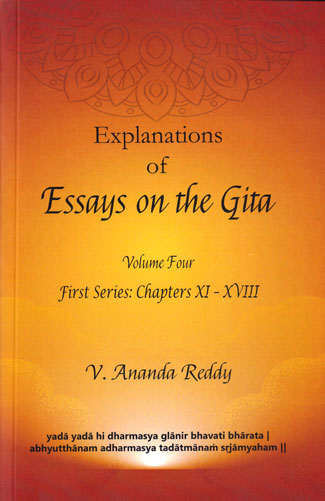
| Price: Rs 375 Pages: 258 Dimensions (in cms): 14x22 ISBN: 978-93-85391-50-7 | Soft Cover | |
| Publisher: Sri Aurobindo Centre for Advanced Research Trust, Pondicherry | ||
 | ||

|
Your cart is empty... |
About Explanations of Essays on the Gita: Volume Four
In these talks delivered in 2010 and 2011, the author examines Chapters Eleven to Eighteen of Sri Aurobindo’s Essays on the Gita. The first three chapters on “Works and Sacrifice”, “The Significance of Sacrifice” and “The Lord of Sacrifice” explore the concepts of yagna, karma, and Brahman (sacrifice, work, and the Absolute). The remaining chapters examine the principle of divine works to be done not for the sake of the world but for a spiritual unity with the Divine; the Gita’s introduction of the concept of the Avatar through Sri Krishna, giving rise to the devotional aspect of yoga; and the process of avatarhood representing the divine descent into a human vessel for the work of overseeing the dual process of inner individual progress and outer collective advancement in the spiritual evolution of consciousness here on earth. Last is the injunction for the divine worker to live in a state of equality, free of any attachment to works, free from the egoism of the doer, free from even the desire to serve.
REVIEW
“The Gita...is a gate opening on the whole world of spiritual truth and experience and the view it gives us embraces all the provinces of that supreme region. It maps out, but it does not cut up or build walls or hedges to confine our vision.” (CWSA 19: 9) Sri Aurobindo explains in the opening chapter of Essays on the Gita that the ultimate truth cannot be confined to a single book or religion. No scripture, philosophy, or wise figure can fully express it because truth is boundless and beyond anything that tries to describe it in time and space. In simpler words, the eternal cannot be completely understood by what is limited. What then can be seen as the ultimate truth? A truth which is universal, is expressed by vision, is lived and experienced, and goes beyond the intellectual mind.
Most scriptures belong to specific eras and are shaped by the culture and circumstances of their time. The Gita, however, transcends these limits because it reveals deeper and living truths that remain universally relevant. It is not a text restricted to one religion, one culture, or one historical period. It is a living doorway into the understanding of life, action, choice, faith, and the inner presence that guides us. Though it was delivered at a specific historical moment on a battlefield, its teachings move far beyond that moment. It speaks to anyone who struggles, hesitates, searches, or stands between doubt and duty. In that sense, the Gita belongs to every age and to every individual who seeks to progress.
Sri Aurobindo explored the universality of this scripture in great depth in his Essays on the Gita. His aim was not only to explain the text, but also to help the reader understandhow its teachings should be perceived and how one can go deeper into its living truths. In harmony with this intention, many thinkers and teachers have reflected on Sri Aurobindo’s interpretation and have offered their own observations. Among them is Dr V. Ananda Reddy, who has published a series of books titled Explanations of Essays on the Gita, which are transcriptions of his summary talks on the book. The talks that form the basis of Volumes Three and Four were delivered at the Sri Aurobindo Centre for Advanced Research (SACAR) between 2007 and 2008 and between 2010 and 2011.
These two volumes in the series cover Chapters 8 to 10 and 11 to 18 of Essays on the Gita. Here, Dr Reddy offers detailed but simple explanations on sections of Sri Aurobindo's book. He enriches his discourses with numerous examples and analogies from daily life. By doing this, he helps the reader see the Gita not as a distant religious text meant only for Arjuna or for a particular historical situation. Instead, it becomes something living and practical, something that any individual can turn to again and again while facing the challenges of daily life.
Volume Three begins with a brief recap of the ideas discussed in earlier volumes. Dr Reddy then gives an overall summary of the chapters he will cover: “Sankhya and Yoga,” “Sankhya Yoga and Vedanta,” and “The Yoga of the Intelligent Will.” He explains that from these chapters onward, Essays on the Gita takes a more philosophical turn. The first seven chapters, as readers may have noticed, focus more on the background of the Mahabharata war, the setting of the battlefield, and the larger meaning of the situation. Sri Aurobindo first helps the reader understand the Gita as a whole: its spirit, its characters, the Divine teacher, the human disciple, and the significance of the battlefield itself. In this way, he prepares the ground so that the reader is ready to follow the teachings and truths that come later.
This structure also reflects the text of the Gita. The first seven chapters of Essays on the Gita mainly relate to the first chapter of the Gita. Then the text becomes more philosophical because it moves into the explanation of the second chapter of the Gita, where the real conversation between Sri Krishna and Arjuna begins. Here Arjuna starts asking questions, and the Divine Teacher slowly reveals the deeper truths by giving him practical solutions based on Vedantic knowledge. Sri Aurobindo even remarks in the tenth chapter, “I have had to deviate in the last two essays and to drag the reader with me into the arid tracts of metaphysical dogma.” (CWSA 19: 94) Dr Reddy points out that it is remarkable how clearly Sri Aurobindo presents a synthesised way of looking at the various schools and systems of Yoga.
“Become My-minded, My lover and adorer, a sacrificer to Me, bow thyself to Me… to Me thou shalt come.” This is one of the most powerful verses of the Gita. Dr Reddy, while analysing how Sri Aurobindo has understood it, remarks that this verse carries the very essence of the Gita’s teaching, which is to merge one’s entire being into the Divine consciousness. It commands the seeker to integrate all the three paths of yoga, Jnana, Bhakti, and Karma, in the journey towards the Purushottama.
To be “My-minded”, he says, is to constantly remember the Divine. To be a “lover and adorer” is Bhakti. To “bow down” and “sacrifice” is Karma Yoga. This is how all three meet in a single path of complete surrender; it is then that the Lord says that the one who lives like this “shall come to Me”.
Dr Reddy also finds a connection between the three paths of yoga and the three ways in which the Gita describes the Divine: the Kshara Purusha, the Akshara Purusha, and the Purushottama. The Kshara Purusha is the changing and active Self present in Nature and in all living beings. It is the aspect of the Divine that “enjoys, participates and is involved” in the world. The Akshara Purusha is the silent, unmoving, and changeless Self. Beyond both is the Uttama Purusha or Purushottama, the Supreme Lord, who holds within himself both unity and multiplicity.
The author uses a beautiful image from the Mundaka Upanishad to explain this. He says that the Kshara and Akshara are like two birds sitting on the branches of a tree, and that tree represents the Purushottama. He continues by explaining that those who practise Karma Yoga are linked with the Kshara Purusha because they live and work in the world. Those who follow Jnana Yoga, or meditation, leading to samadhi, seek the Akshara Purusha. But the Gita explains that the fullest truth is the Purushottama, who includes both the world and what lies beyond it. If we turn only to the Akshara, we may withdraw from life and reject it. If we turn only to the Kshara, we may get lost in ignorance and forget the higher reality. But in the Purushottama, we discover a harmony; we can live and act in the world while remaining inwardly detached from it, and continue our journey towards the Divine. Only then can a complete transformation of the being become possible.
After explaining the synthesis of Sankhya and Yoga, Volume Four turns to the next eight chapters, from “Works and Sacrifice” (Chapter 11) to “The Divine Worker” (Chapter 18). Here Sri Aurobindo begins to write about the third chapter of the Gita, which deals with Karmayoga. At the beginning of this chapter, Arjuna is confused. Earlier, Krishna had told him that actions arise from ignorance and are the principal cause of ego and desire, so Arjuna felt that renouncing action and following only the path of knowledge was the right way. But now Krishna tells him that action is also essential and must not be rejected.
When Arjuna cannot understand what he is really expected to do, Krishna reveals the idea of Naishkarmya. Action should not be abandoned; instead, it should be carried out with complete detachment from its results, with the knowledge that all work is moved by Prakriti and is part of the Divine play. The fruits of action, whether good or bad, do not belong to the doer. He must act in complete calmness and with inner quietude. But what will this silence awaken within the individual?
To answer this, Dr Reddy uses the image of a still lake. When the water is calm, our reflection is clear. In the same way, the Purusha is reflected in us only when our inner being is silent and the three gunas are at rest. But when the gunas are disturbed, or when a person begins to feel that all action is “mine,” the image of the Purusha becomes distorted and the ego blocks the Divine guidance. As Dr Reddy writes, “If the gunas can be brought back to stillness, the image of the Purusha may once again become accessible to consciousness.”
Volumes Three and Four of Dr Reddy’s Explanations of Essays on the Gita work best as guides to Sri Aurobindo’s ideas on the Gita. Because Sri Aurobindo’s explanations can sometimes seem dense for both new and regular readers, a simple and clear analysis is often needed to understand their depth. Dr Reddy does not try to alter or reinterpret the original text. His work depends entirely on what Sri Aurobindo has written. The books do not offer summaries or a detailed academic analysis. Instead, they provide simple explanations of selected passages. What makes these explanations interesting are the frequent references to daily life experiences, personal anecdotes, analogies, imagery from ancient texts, and references to other works of Sri Aurobindo and the Mother.
At the same time, in his effort to simplify, Dr Reddy sometimes repeats or over-explains certain ideas, which may feel redundant or slow-paced for readers who are already familiar with Sri Aurobindo’s writings. However, he mentions at the beginning that each volume comprises transcriptions of talks delivered over a year, and because there were often long gaps between classes, he had to revisit earlier points before moving ahead. Moreover, repetition is almost unavoidable when explaining the Gita, because its ideas are so deeply interconnected.
This style may actually work better for talks than for books, since the tone is conversational and can feel quite lengthy when read continuously. There are, however, two sides to this approach. On one side, the conversational tone makes the book feel less like an academic text and more like a conversation between the author and the reader. This helps new readers understand the insights, especially since Dr Reddy often relates philosophical and metaphysical ideas to everyday life or explains them through simple imagery from the Upanishads.
However, this format also means that readers should ideally keep Essays on the Gita beside them. If the commentary is read on its own, one may feel a little lost because Dr Reddy often does not go into the deeper meanings of specific terms or sentences. His explanations usually offer only an overview of the selected paragraph or the central idea of the chapter. It is therefore better to read the commentary alongside the original text, so that when certain details are omitted, the reader can still refer to the surrounding paragraphs and understand the fuller context. By repeatedly referring to the works of Sri Aurobindo and the Mother, Dr Reddy also draws a connection between the teachings of the Gita and the path of the Integral Yoga developed by them. He shows that their strongest connection is the central teaching of surrender to the Divine. Surrender is the very soul of yoga, because one cannot progress without dissolving the ego and accepting the presence of a higher power that guides all action. Dr Reddy points out that Sri Aurobindo often takes the ideas of the Gita a step further and explores them more deeply. In the Gita, when Arjuna hesitates to act, Sri Krishna reveals that it is the Lord who truly acts, and that Arjuna is only an instrument of His will.
Sri Aurobindo takes this teaching further by explaining how difficult this acceptance can be for an individual. The ego naturally resists the idea of not being the doer. As the individual struggles with this, the process often feels slow and discouraging. A belief begins to arise that surrender is unattainable, that the Divine is distant, separate from ourselves, and completely opposed to us and the world we live in.
Sri Aurobindo therefore clarifies that the Divine is not only outside us, but has always been present within us. As He creates us, He leaves a part of Himself in us. Surrender, then, should not be done out of fear or with the desire to gain something in return, nor should it be treated as a rigid rule to follow. One simply needs to turn inward, become self-aware and conscious of this inner presence. In this way, surrender ceases to be a strict practice and becomes, in Sri Aurobindo’s vision, a way of living.
The books may not satisfy readers who are looking for an academic or critical study, but they are helpful for those who want guidance while reading the Gita in the light of Sri Aurobindo’s thought. The references and clarifications act as bridges between the seeker and the text, making the ideas not only clearer and easier to grasp, but also more alive and approachable. The reader is encouraged to look around, observe life, and realise that the Gita is not merely a religious scripture, but a living guide to be remembered and practiced in everyday life.
—Ritaja Mishra
Ritaja is a recent graduate of the Sri Aurobindo International Centre of Education who is interested in writing and Indian culture.
February 2026
Most scriptures belong to specific eras and are shaped by the culture and circumstances of their time. The Gita, however, transcends these limits because it reveals deeper and living truths that remain universally relevant. It is not a text restricted to one religion, one culture, or one historical period. It is a living doorway into the understanding of life, action, choice, faith, and the inner presence that guides us. Though it was delivered at a specific historical moment on a battlefield, its teachings move far beyond that moment. It speaks to anyone who struggles, hesitates, searches, or stands between doubt and duty. In that sense, the Gita belongs to every age and to every individual who seeks to progress.
Sri Aurobindo explored the universality of this scripture in great depth in his Essays on the Gita. His aim was not only to explain the text, but also to help the reader understandhow its teachings should be perceived and how one can go deeper into its living truths. In harmony with this intention, many thinkers and teachers have reflected on Sri Aurobindo’s interpretation and have offered their own observations. Among them is Dr V. Ananda Reddy, who has published a series of books titled Explanations of Essays on the Gita, which are transcriptions of his summary talks on the book. The talks that form the basis of Volumes Three and Four were delivered at the Sri Aurobindo Centre for Advanced Research (SACAR) between 2007 and 2008 and between 2010 and 2011.
These two volumes in the series cover Chapters 8 to 10 and 11 to 18 of Essays on the Gita. Here, Dr Reddy offers detailed but simple explanations on sections of Sri Aurobindo's book. He enriches his discourses with numerous examples and analogies from daily life. By doing this, he helps the reader see the Gita not as a distant religious text meant only for Arjuna or for a particular historical situation. Instead, it becomes something living and practical, something that any individual can turn to again and again while facing the challenges of daily life.
Volume Three begins with a brief recap of the ideas discussed in earlier volumes. Dr Reddy then gives an overall summary of the chapters he will cover: “Sankhya and Yoga,” “Sankhya Yoga and Vedanta,” and “The Yoga of the Intelligent Will.” He explains that from these chapters onward, Essays on the Gita takes a more philosophical turn. The first seven chapters, as readers may have noticed, focus more on the background of the Mahabharata war, the setting of the battlefield, and the larger meaning of the situation. Sri Aurobindo first helps the reader understand the Gita as a whole: its spirit, its characters, the Divine teacher, the human disciple, and the significance of the battlefield itself. In this way, he prepares the ground so that the reader is ready to follow the teachings and truths that come later.
This structure also reflects the text of the Gita. The first seven chapters of Essays on the Gita mainly relate to the first chapter of the Gita. Then the text becomes more philosophical because it moves into the explanation of the second chapter of the Gita, where the real conversation between Sri Krishna and Arjuna begins. Here Arjuna starts asking questions, and the Divine Teacher slowly reveals the deeper truths by giving him practical solutions based on Vedantic knowledge. Sri Aurobindo even remarks in the tenth chapter, “I have had to deviate in the last two essays and to drag the reader with me into the arid tracts of metaphysical dogma.” (CWSA 19: 94) Dr Reddy points out that it is remarkable how clearly Sri Aurobindo presents a synthesised way of looking at the various schools and systems of Yoga.
“Become My-minded, My lover and adorer, a sacrificer to Me, bow thyself to Me… to Me thou shalt come.” This is one of the most powerful verses of the Gita. Dr Reddy, while analysing how Sri Aurobindo has understood it, remarks that this verse carries the very essence of the Gita’s teaching, which is to merge one’s entire being into the Divine consciousness. It commands the seeker to integrate all the three paths of yoga, Jnana, Bhakti, and Karma, in the journey towards the Purushottama.
To be “My-minded”, he says, is to constantly remember the Divine. To be a “lover and adorer” is Bhakti. To “bow down” and “sacrifice” is Karma Yoga. This is how all three meet in a single path of complete surrender; it is then that the Lord says that the one who lives like this “shall come to Me”.
Dr Reddy also finds a connection between the three paths of yoga and the three ways in which the Gita describes the Divine: the Kshara Purusha, the Akshara Purusha, and the Purushottama. The Kshara Purusha is the changing and active Self present in Nature and in all living beings. It is the aspect of the Divine that “enjoys, participates and is involved” in the world. The Akshara Purusha is the silent, unmoving, and changeless Self. Beyond both is the Uttama Purusha or Purushottama, the Supreme Lord, who holds within himself both unity and multiplicity.
The author uses a beautiful image from the Mundaka Upanishad to explain this. He says that the Kshara and Akshara are like two birds sitting on the branches of a tree, and that tree represents the Purushottama. He continues by explaining that those who practise Karma Yoga are linked with the Kshara Purusha because they live and work in the world. Those who follow Jnana Yoga, or meditation, leading to samadhi, seek the Akshara Purusha. But the Gita explains that the fullest truth is the Purushottama, who includes both the world and what lies beyond it. If we turn only to the Akshara, we may withdraw from life and reject it. If we turn only to the Kshara, we may get lost in ignorance and forget the higher reality. But in the Purushottama, we discover a harmony; we can live and act in the world while remaining inwardly detached from it, and continue our journey towards the Divine. Only then can a complete transformation of the being become possible.
After explaining the synthesis of Sankhya and Yoga, Volume Four turns to the next eight chapters, from “Works and Sacrifice” (Chapter 11) to “The Divine Worker” (Chapter 18). Here Sri Aurobindo begins to write about the third chapter of the Gita, which deals with Karmayoga. At the beginning of this chapter, Arjuna is confused. Earlier, Krishna had told him that actions arise from ignorance and are the principal cause of ego and desire, so Arjuna felt that renouncing action and following only the path of knowledge was the right way. But now Krishna tells him that action is also essential and must not be rejected.
When Arjuna cannot understand what he is really expected to do, Krishna reveals the idea of Naishkarmya. Action should not be abandoned; instead, it should be carried out with complete detachment from its results, with the knowledge that all work is moved by Prakriti and is part of the Divine play. The fruits of action, whether good or bad, do not belong to the doer. He must act in complete calmness and with inner quietude. But what will this silence awaken within the individual?
To answer this, Dr Reddy uses the image of a still lake. When the water is calm, our reflection is clear. In the same way, the Purusha is reflected in us only when our inner being is silent and the three gunas are at rest. But when the gunas are disturbed, or when a person begins to feel that all action is “mine,” the image of the Purusha becomes distorted and the ego blocks the Divine guidance. As Dr Reddy writes, “If the gunas can be brought back to stillness, the image of the Purusha may once again become accessible to consciousness.”
Volumes Three and Four of Dr Reddy’s Explanations of Essays on the Gita work best as guides to Sri Aurobindo’s ideas on the Gita. Because Sri Aurobindo’s explanations can sometimes seem dense for both new and regular readers, a simple and clear analysis is often needed to understand their depth. Dr Reddy does not try to alter or reinterpret the original text. His work depends entirely on what Sri Aurobindo has written. The books do not offer summaries or a detailed academic analysis. Instead, they provide simple explanations of selected passages. What makes these explanations interesting are the frequent references to daily life experiences, personal anecdotes, analogies, imagery from ancient texts, and references to other works of Sri Aurobindo and the Mother.
At the same time, in his effort to simplify, Dr Reddy sometimes repeats or over-explains certain ideas, which may feel redundant or slow-paced for readers who are already familiar with Sri Aurobindo’s writings. However, he mentions at the beginning that each volume comprises transcriptions of talks delivered over a year, and because there were often long gaps between classes, he had to revisit earlier points before moving ahead. Moreover, repetition is almost unavoidable when explaining the Gita, because its ideas are so deeply interconnected.
This style may actually work better for talks than for books, since the tone is conversational and can feel quite lengthy when read continuously. There are, however, two sides to this approach. On one side, the conversational tone makes the book feel less like an academic text and more like a conversation between the author and the reader. This helps new readers understand the insights, especially since Dr Reddy often relates philosophical and metaphysical ideas to everyday life or explains them through simple imagery from the Upanishads.
However, this format also means that readers should ideally keep Essays on the Gita beside them. If the commentary is read on its own, one may feel a little lost because Dr Reddy often does not go into the deeper meanings of specific terms or sentences. His explanations usually offer only an overview of the selected paragraph or the central idea of the chapter. It is therefore better to read the commentary alongside the original text, so that when certain details are omitted, the reader can still refer to the surrounding paragraphs and understand the fuller context. By repeatedly referring to the works of Sri Aurobindo and the Mother, Dr Reddy also draws a connection between the teachings of the Gita and the path of the Integral Yoga developed by them. He shows that their strongest connection is the central teaching of surrender to the Divine. Surrender is the very soul of yoga, because one cannot progress without dissolving the ego and accepting the presence of a higher power that guides all action. Dr Reddy points out that Sri Aurobindo often takes the ideas of the Gita a step further and explores them more deeply. In the Gita, when Arjuna hesitates to act, Sri Krishna reveals that it is the Lord who truly acts, and that Arjuna is only an instrument of His will.
Sri Aurobindo takes this teaching further by explaining how difficult this acceptance can be for an individual. The ego naturally resists the idea of not being the doer. As the individual struggles with this, the process often feels slow and discouraging. A belief begins to arise that surrender is unattainable, that the Divine is distant, separate from ourselves, and completely opposed to us and the world we live in.
Sri Aurobindo therefore clarifies that the Divine is not only outside us, but has always been present within us. As He creates us, He leaves a part of Himself in us. Surrender, then, should not be done out of fear or with the desire to gain something in return, nor should it be treated as a rigid rule to follow. One simply needs to turn inward, become self-aware and conscious of this inner presence. In this way, surrender ceases to be a strict practice and becomes, in Sri Aurobindo’s vision, a way of living.
The books may not satisfy readers who are looking for an academic or critical study, but they are helpful for those who want guidance while reading the Gita in the light of Sri Aurobindo’s thought. The references and clarifications act as bridges between the seeker and the text, making the ideas not only clearer and easier to grasp, but also more alive and approachable. The reader is encouraged to look around, observe life, and realise that the Gita is not merely a religious scripture, but a living guide to be remembered and practiced in everyday life.
—Ritaja Mishra
Ritaja is a recent graduate of the Sri Aurobindo International Centre of Education who is interested in writing and Indian culture.
February 2026
