

Time-Steps of The Cosmic Horse
The Contemplative Philosophy of the Great Forest (Bṛhadāraṇyaka) Upaniṣad
— Debashish Banerji
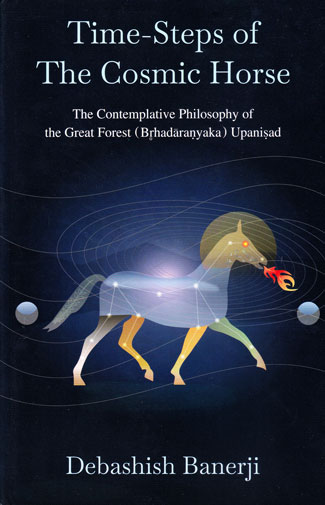
| Price: Rs 1100 Pages: 335 Dimensions (in cms): 14x22 ISBN: 978-81-246-1228-6 | Hard Cover | |
| Publisher: Nalanda International, Los Angeles, USA, and D. K. Printworld, New Delhi, India | ||
 | ||

|
Your cart is empty... |
About Time-Steps of The Cosmic Horse
Time-Steps of the Cosmic Horse is a sustained contemplation on the first chapter of the Bṛhadāraṇyaka Upanishad, the earliest text in its genre, inaugurating the entire history of Indian philosophy. The author’s approach avoids the ideological, constricted interpretation of the traditional Vedantins, rather viewing this Upanishad’s countercultural, rhetorical style of thought as creating a space of “unmediated relationship and identity” between the individual and the One. In this approach he finds a deeper consonance with the vision of Sri Aurobindo, insisting on a true and complete self-knowing in the Supreme Reality.
REVIEW
The book under review is a translation of and commentary on the ancient Bṛhadāraṇyaka Upaniṣad. It covers the first two adhyāyas or chapters, which together make up the Madhu Kāṇḍa or the first Book of the Upaniṣad. Sri Aurobindo has said of this Upaniṣad that it is “at once the most obscure and the profoundest of the Upanishads...If its ideas are remote from us, its language is still more remote...it has preferred to couch its ideas in a highly figurative and symbolical language.” [CWSA 18: 273]
The book consists of a Preface, followed by a 36-page introduction. Then follows the main body of the work: six chapters, each beginning with a translation of the Sanskrit text and followed by a detailed commentary on that section. There is a very useful appendix which gives the relevant Sanskrit text, both in Devanagari and in transliteration, plus the translation. The book concludes with a bibliography and an index.
The Preface gives a timeline of Dr Banerji’s engagement with the Upaniṣads generally, and with the Bṛhadāraṇyaka Upaniṣad in particular. It was mostly through the writings of Sri Aurobindo that the author was moved to give several series of lectures, which resulted in two books on the Upaniṣads: Meditations on the Īśa Upaniṣad (2020) and the present work, Time-Steps of the Cosmic Horse, subtitled The Contemplative Philosophy of the Great Forest (Bṛhadāraṇyaka) Upaniṣad (2024).
The substantial introduction outlines many aspects of the Bṛhadāraṇyaka Upaniṣad, indicating the author’s approach to it. This Upaniṣad has its origins in the Āraṇyakas or “forest texts”. The author suggests that the Āraṇyakas represent “a counterculture seeking for freedom and unmediated access to truth” at a time when the Vedas had become “the foundation for a ritually ordered symbolic society”. They were “‘forest texts’ (Āraṇyakas) or texts of contemplative insights belonging to ‘the outside’ of the ritual system”, traditionally attributed to the Sage Yājñavalkya, who, it seems, moved between the quiet surroundings of his forest ashram and the court of King Janaka, his patron. “The Bṛhadāraṇyaka Upaniṣad also features prominently the courtly caste of kṣatriyas as beings of wisdom, often with knowledge of Brahman not available to many brāhmaṇas, who are stuck in conventional or rote learning.” Some scholars are of the view that “the Upaniṣads were reform literature composed by kṣatriyas seeking to overcome the priestly hegemony of the Brāhmaṇas.” The Bṛhadāraṇyaka Upaniṣad is among the earliest texts to introduce the terms Brahman and ātman. “Brahman, a principle and a Being, the only Being there is, one without a second (ekamevādvitīyam) and ātman, self, individual yet not separate from Brahman.… To realize one’s ātman is to realize Brahman as oneself.”
One section of the introduction is titled “Reinterpreting the Veda”. It refers to the traditional view of the Vedas, “normalized by the fourteenth-century scholar, Sāyaṇācārya, as well as the modern Western view, following his lead,” which viewed the Vedic hymns in a mostly ritualistic sense. However, even Sāyaṇa’s ritualistic interpretation could not conceal totally the remnants of “the old spiritual, philosophic or psychological interpretations of the Sruti” (CWSA 15:21). Sri Aurobindo has called Sāyaṇa’s work “indispensable”, even while finally leaving it behind in his reinterpretation of the Veda.
Dr Banerji points out that “to the Vedic poets, the two primary animals of domestication, the cow and the horse, took on the highest significance, the cow as a symbol of Knowledge and the horse as a symbol of Power. If Aditi the Mother of the solar gods is seen as a Cow, the Horse is related to war and sacrifice. In ritual terms, the Horse was associated with kingship and coronation, specifically the Aśvamedha sacrifice for establishing emperors (cakravartins).” It is this sacrificial Horse of the Aśvamedha ritual that opens the first adhyāya of the Bṛhadāraṇyaka Upaniṣad.
The author draws an interesting comparison to the Puruṣa Sūktam (Rig Veda X.90) “according to which a multi-limbed ‘Person’ (Puruṣa) is born as the cosmos and allows itself to be sacrificed by the gods, its parts making up the constituents of the cosmos.… In the Veda, the sacrifice is that of Puruṣa, what seems to be a hyper-anthropic Person. In fact, the only specifically anthropic sign about Puruṣa is the mention of “arms” (bāhu), implying a standing two-footed creature, rather than the forelegs and hind legs (together generalized as limbs, aṅga) of a four-footed creature such as a horse, as in the Bṛhadāraṇyaka Upaniṣad.”
There are striking correspondences between the various parts of the Upanishadic Horse and the Puruṣa of the Veda, which the author investigates in some detail. He also draws attention to several other themes from the Veda which appear in the Bṛhadāraṇyaka Upaniṣad.
Another section of the introduction is titled “The Three” and explains that “the cosmological equivalence of the three gods (Sun, Wind and Fire at the macrocosmic level) and the three faculties (sight, breath and speech at the microcosmic) pervades the first chapter (adhyāya) of the Bṛhadāraṇyaka Upaniṣad. We also see a privileging of breath prāṇa...an indication of the relationship of this text with the kṣatriya, since the Wind God (Vāyu) and its microcosmic counterpart prāṇa (Life-force) represent the energetic element among the three sets of correspondences. Sun-sight, the element of Illumination and Wisdom, could be considered primary to the brāhmaṇa; Wind-breath, element of Energy and Strength, primary to the kṣatriya, Fire-speech, element of Aspiration and Circulation, in its collective or universal aspect, primary to the vaiśya.”
In this long passage the author states that his interpretation of the Bṛhadāraṇyaka Upaniṣad has running through it “the historical conjecture that the Upaniṣads represent a revision of the ideas of the Veda through the foregrounding of unmediated relationality between the individual and absolute conscious Being. This is announced eponymously in its self-identification as upaniṣad (sitting-close) in contradistinction to Veda (knowledge), through the revision of the term Brahman to mean absolute reality and through the invention of the term ātman, meaning Self… The central message is one of the self of each individual being a self-presentation of absolute Being in its self-becoming. In its origins, this is likely to have been a minor movement,”… but nonetheless “a cultural expression designed to resist and escape the hegemonic capture of the state apparatus. The importance of the politics of language to this cultural milieu can be understood by analogy to our time, when the word ‘science’, literally meaning knowledge, has totalized the entire field of knowing, both in content and method. The term veda applied to the Saṁhitās and ritual texts (Brāhmaṇas) structuring and defining Vedic society and also meaning ‘knowledge’ should be seen as playing a very similar, if not identical role to the society named after it by the eighth century BCE. It defines a social ontology determined by a certain epistemology which is its scriptural bedrock translated into static form through the assignment of hereditary and hierarchic symbolic roles and dynamic form through operational ritual conventions among these roles. Within this society, a literary movement naming itself Upaniṣad and extending a teaching of universal fundamental identity with conscious truth is clearly revolutionary.”
The author mentions some of the principal schools of Vedānta in India and discusses the interpretations of Śaṅkarācārya and Rāmānuja. He also refers to the work of Sri Aurobindo on the Upaniṣads, most notably, the full translations and extensive commentaries on the Īśa Upaniṣad and Kena Upaniṣad. According to Dr Banerji, the central vision of the Īśa Upaniṣad as seen by Sri Aurobindo “may be summarized as defining a goal of becoming as identification in consciousness (yoga) with a plane in which absolute monism and infinite pluralism coexist without erasing or subordinating the other. Attainment of this plane of consciousness, which he identified as vijñāna in the Upaniṣads, became the central teaching of Sri Aurobindo’s yoga”.
Concerning the question of absolute meaning versus interpretation, the author holds that “the hermeneutic search for an absolute truth through academic method is spurious and hides the fascist aim of subjecting infinite and essential multiplicity to an exclusive interpretation.” The Īśa Upaniṣad itself gives a warning of this in the ninth verse:
tato bhūya iva te tamo ya u vidyāyāṁ ratāḥ.
This is translated by Sri Aurobindo as “they as if into a greater darkness who devote themselves to the Knowledge alone”. Instead of this exclusive interpretation, the author takes a position which “affirms a plurality of interpretations for any object of enquiry”. What he calls the “hermeneutics of immanence” “rests on a close reading of the text along with an interpretation of the cultural history of the work, in engagement with a paradoxical goal of becoming towards a plane in which absolute monism and radical pluralism coexist as one without erasing or subordinating the other”.
One can sense the author’s appreciation for the Sanskrit language and what he calls “the cunning style of language of the Upaniṣads” with its many devices and figures of speech. “Literary choices, such as a flexible use of metaphor, paradox, polysemy, puns, puzzles, gnomic parables and the use of the syntax-free property of Sanskrit” necessarily give rise to a contemplative approach to the original text, from which follows space for multiple interpretations, intuitions and revelations of its original sense.
The work has its origins in a series of lectures, and the text occasionally reads as though proofreading for the book was not very thorough. It seems to suffer from a lack of commas, or else, commas put in the wrong place, giving rise to ambiguities and the need to re-read sentences. At the beginning of the introduction, there is some confusion between the terms Adhyāya meaning chapter, and Brāhmaṇa meaning section. After several occurrences, this gets permanently corrected. Creditably, not a single error appears in the Sanskrit, neither in the Devanāgarī nor in the transliteration. The addition of reference numbers at the head of each page of the appendix would significantly improve the usability of the book. Some sections (Brāhmaṇas) of the Upaniṣad contain many verses, and it sometimes requires considerable thumbing of pages back and forth to find one’s bearings. Improved referencing in the main part of the book would be useful also.
According to the cover notes, this is not a work of explanation but a contemplative approach towards cosmic and nondual self-realization. For students of philosophy and for those interested in the Upaniṣads, there is a wealth of insightful material here that could seed further enquiry. In terms of the detailed analysis of the symbology and the interesting sidelights on the Upaniṣad itself, The Time-Steps of the Cosmic Horse represents a valuable research and a significant aid to the study of this most ancient Upaniṣad.
—Bryce Grinlington
Bryce worked as an electrical engineer in Australia before coming to India. At the Sri Aurobindo Ashram He has worked at the Archives and Research Library, and at present teaches music at SAICE.
August 2025
The book consists of a Preface, followed by a 36-page introduction. Then follows the main body of the work: six chapters, each beginning with a translation of the Sanskrit text and followed by a detailed commentary on that section. There is a very useful appendix which gives the relevant Sanskrit text, both in Devanagari and in transliteration, plus the translation. The book concludes with a bibliography and an index.
The Preface gives a timeline of Dr Banerji’s engagement with the Upaniṣads generally, and with the Bṛhadāraṇyaka Upaniṣad in particular. It was mostly through the writings of Sri Aurobindo that the author was moved to give several series of lectures, which resulted in two books on the Upaniṣads: Meditations on the Īśa Upaniṣad (2020) and the present work, Time-Steps of the Cosmic Horse, subtitled The Contemplative Philosophy of the Great Forest (Bṛhadāraṇyaka) Upaniṣad (2024).
The substantial introduction outlines many aspects of the Bṛhadāraṇyaka Upaniṣad, indicating the author’s approach to it. This Upaniṣad has its origins in the Āraṇyakas or “forest texts”. The author suggests that the Āraṇyakas represent “a counterculture seeking for freedom and unmediated access to truth” at a time when the Vedas had become “the foundation for a ritually ordered symbolic society”. They were “‘forest texts’ (Āraṇyakas) or texts of contemplative insights belonging to ‘the outside’ of the ritual system”, traditionally attributed to the Sage Yājñavalkya, who, it seems, moved between the quiet surroundings of his forest ashram and the court of King Janaka, his patron. “The Bṛhadāraṇyaka Upaniṣad also features prominently the courtly caste of kṣatriyas as beings of wisdom, often with knowledge of Brahman not available to many brāhmaṇas, who are stuck in conventional or rote learning.” Some scholars are of the view that “the Upaniṣads were reform literature composed by kṣatriyas seeking to overcome the priestly hegemony of the Brāhmaṇas.” The Bṛhadāraṇyaka Upaniṣad is among the earliest texts to introduce the terms Brahman and ātman. “Brahman, a principle and a Being, the only Being there is, one without a second (ekamevādvitīyam) and ātman, self, individual yet not separate from Brahman.… To realize one’s ātman is to realize Brahman as oneself.”
One section of the introduction is titled “Reinterpreting the Veda”. It refers to the traditional view of the Vedas, “normalized by the fourteenth-century scholar, Sāyaṇācārya, as well as the modern Western view, following his lead,” which viewed the Vedic hymns in a mostly ritualistic sense. However, even Sāyaṇa’s ritualistic interpretation could not conceal totally the remnants of “the old spiritual, philosophic or psychological interpretations of the Sruti” (CWSA 15:21). Sri Aurobindo has called Sāyaṇa’s work “indispensable”, even while finally leaving it behind in his reinterpretation of the Veda.
Dr Banerji points out that “to the Vedic poets, the two primary animals of domestication, the cow and the horse, took on the highest significance, the cow as a symbol of Knowledge and the horse as a symbol of Power. If Aditi the Mother of the solar gods is seen as a Cow, the Horse is related to war and sacrifice. In ritual terms, the Horse was associated with kingship and coronation, specifically the Aśvamedha sacrifice for establishing emperors (cakravartins).” It is this sacrificial Horse of the Aśvamedha ritual that opens the first adhyāya of the Bṛhadāraṇyaka Upaniṣad.
The author draws an interesting comparison to the Puruṣa Sūktam (Rig Veda X.90) “according to which a multi-limbed ‘Person’ (Puruṣa) is born as the cosmos and allows itself to be sacrificed by the gods, its parts making up the constituents of the cosmos.… In the Veda, the sacrifice is that of Puruṣa, what seems to be a hyper-anthropic Person. In fact, the only specifically anthropic sign about Puruṣa is the mention of “arms” (bāhu), implying a standing two-footed creature, rather than the forelegs and hind legs (together generalized as limbs, aṅga) of a four-footed creature such as a horse, as in the Bṛhadāraṇyaka Upaniṣad.”
There are striking correspondences between the various parts of the Upanishadic Horse and the Puruṣa of the Veda, which the author investigates in some detail. He also draws attention to several other themes from the Veda which appear in the Bṛhadāraṇyaka Upaniṣad.
Another section of the introduction is titled “The Three” and explains that “the cosmological equivalence of the three gods (Sun, Wind and Fire at the macrocosmic level) and the three faculties (sight, breath and speech at the microcosmic) pervades the first chapter (adhyāya) of the Bṛhadāraṇyaka Upaniṣad. We also see a privileging of breath prāṇa...an indication of the relationship of this text with the kṣatriya, since the Wind God (Vāyu) and its microcosmic counterpart prāṇa (Life-force) represent the energetic element among the three sets of correspondences. Sun-sight, the element of Illumination and Wisdom, could be considered primary to the brāhmaṇa; Wind-breath, element of Energy and Strength, primary to the kṣatriya, Fire-speech, element of Aspiration and Circulation, in its collective or universal aspect, primary to the vaiśya.”
In this long passage the author states that his interpretation of the Bṛhadāraṇyaka Upaniṣad has running through it “the historical conjecture that the Upaniṣads represent a revision of the ideas of the Veda through the foregrounding of unmediated relationality between the individual and absolute conscious Being. This is announced eponymously in its self-identification as upaniṣad (sitting-close) in contradistinction to Veda (knowledge), through the revision of the term Brahman to mean absolute reality and through the invention of the term ātman, meaning Self… The central message is one of the self of each individual being a self-presentation of absolute Being in its self-becoming. In its origins, this is likely to have been a minor movement,”… but nonetheless “a cultural expression designed to resist and escape the hegemonic capture of the state apparatus. The importance of the politics of language to this cultural milieu can be understood by analogy to our time, when the word ‘science’, literally meaning knowledge, has totalized the entire field of knowing, both in content and method. The term veda applied to the Saṁhitās and ritual texts (Brāhmaṇas) structuring and defining Vedic society and also meaning ‘knowledge’ should be seen as playing a very similar, if not identical role to the society named after it by the eighth century BCE. It defines a social ontology determined by a certain epistemology which is its scriptural bedrock translated into static form through the assignment of hereditary and hierarchic symbolic roles and dynamic form through operational ritual conventions among these roles. Within this society, a literary movement naming itself Upaniṣad and extending a teaching of universal fundamental identity with conscious truth is clearly revolutionary.”
The author mentions some of the principal schools of Vedānta in India and discusses the interpretations of Śaṅkarācārya and Rāmānuja. He also refers to the work of Sri Aurobindo on the Upaniṣads, most notably, the full translations and extensive commentaries on the Īśa Upaniṣad and Kena Upaniṣad. According to Dr Banerji, the central vision of the Īśa Upaniṣad as seen by Sri Aurobindo “may be summarized as defining a goal of becoming as identification in consciousness (yoga) with a plane in which absolute monism and infinite pluralism coexist without erasing or subordinating the other. Attainment of this plane of consciousness, which he identified as vijñāna in the Upaniṣads, became the central teaching of Sri Aurobindo’s yoga”.
Concerning the question of absolute meaning versus interpretation, the author holds that “the hermeneutic search for an absolute truth through academic method is spurious and hides the fascist aim of subjecting infinite and essential multiplicity to an exclusive interpretation.” The Īśa Upaniṣad itself gives a warning of this in the ninth verse:
tato bhūya iva te tamo ya u vidyāyāṁ ratāḥ.
This is translated by Sri Aurobindo as “they as if into a greater darkness who devote themselves to the Knowledge alone”. Instead of this exclusive interpretation, the author takes a position which “affirms a plurality of interpretations for any object of enquiry”. What he calls the “hermeneutics of immanence” “rests on a close reading of the text along with an interpretation of the cultural history of the work, in engagement with a paradoxical goal of becoming towards a plane in which absolute monism and radical pluralism coexist as one without erasing or subordinating the other”.
One can sense the author’s appreciation for the Sanskrit language and what he calls “the cunning style of language of the Upaniṣads” with its many devices and figures of speech. “Literary choices, such as a flexible use of metaphor, paradox, polysemy, puns, puzzles, gnomic parables and the use of the syntax-free property of Sanskrit” necessarily give rise to a contemplative approach to the original text, from which follows space for multiple interpretations, intuitions and revelations of its original sense.
The work has its origins in a series of lectures, and the text occasionally reads as though proofreading for the book was not very thorough. It seems to suffer from a lack of commas, or else, commas put in the wrong place, giving rise to ambiguities and the need to re-read sentences. At the beginning of the introduction, there is some confusion between the terms Adhyāya meaning chapter, and Brāhmaṇa meaning section. After several occurrences, this gets permanently corrected. Creditably, not a single error appears in the Sanskrit, neither in the Devanāgarī nor in the transliteration. The addition of reference numbers at the head of each page of the appendix would significantly improve the usability of the book. Some sections (Brāhmaṇas) of the Upaniṣad contain many verses, and it sometimes requires considerable thumbing of pages back and forth to find one’s bearings. Improved referencing in the main part of the book would be useful also.
According to the cover notes, this is not a work of explanation but a contemplative approach towards cosmic and nondual self-realization. For students of philosophy and for those interested in the Upaniṣads, there is a wealth of insightful material here that could seed further enquiry. In terms of the detailed analysis of the symbology and the interesting sidelights on the Upaniṣad itself, The Time-Steps of the Cosmic Horse represents a valuable research and a significant aid to the study of this most ancient Upaniṣad.
—Bryce Grinlington
Bryce worked as an electrical engineer in Australia before coming to India. At the Sri Aurobindo Ashram He has worked at the Archives and Research Library, and at present teaches music at SAICE.
August 2025
