

Reflections on Passages in Savitri
— Larry Seidlitz
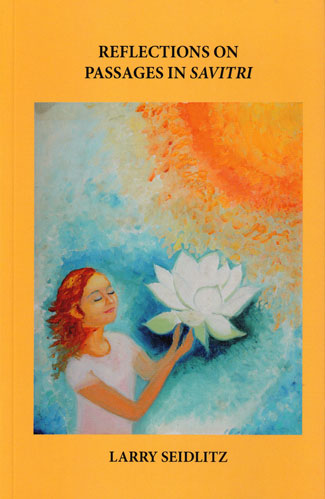
| Price: Rs 250 Pages: 188 Dimensions (in cms): 14x22 ISBN: 978-81-974549-2-9 | Soft Cover | |
| Publisher: Savitri Bhavan, Auroville | ||
 | ||

|
Your cart is empty... |
About Reflections on Passages in Savitri
In this book the author comments on a sampling of significant passages in Savitri that convey a wide-ranging yet insightful view of Sri Aurobindo’s spiritual teaching. He often draws on prose works of Sri Aurobindo and the Mother for context in understanding the themes of Savitri. Beginning with the highly symbolic opening passage of the poem, he proceeds in subsequent chapters to examine themes such as the parallels between King Aswapati and Savitri, and Sri Aurobindo and the Mother, respectively, in the context of their work for the world. Love in its higher possibilities, the role of the soul, the layers of our inner being, the question of fate and free will, the debate with Death, and the higher reaches of spiritual consciousness are other themes explored. The final two chapters highlight passages about the divine, supramental worlds pressing for manifestation in our material world as the pioneering spiritual work of Sri Aurobindo and the Mother.
REVIEW
Reflections on Passages in Savitri by Larry Seidlitz presents an analytical commentary on select passages of Sri Aurobindo’s Savitri: a Legend and a Symbol. The passages chosen are significantly relevant in the context of Sri Aurobindo’s philosophy as a whole and make for an important and meaningful study of the epic. It is an extensive study of substantial passages spread over twelve chapters, whose titles give an initial clue to their contents. Each chapter is an illuminating discussion on profound themes in the poem and on Sri Aurobindo’s complex spiritual vision. In exploring Savitri thus, through some significant passages, the author focusses on how the epic poem was related to the poet’s “development of his own spiritual consciousness”, and also for the “transmission of his spiritual teaching and influence into the world”.
The first chapter, aptly titled “The Symbol Dawn”, considers the opening passage of Savitri in Canto 1 of Book I, giving a wide view of the subject, even while introducing it to the reader. The first 185 lines are selected for discussion, in which the author gives an account of all the six phases of dawn and their symbolic meanings and spiritual significance in relation to the poem. The discussion also rounds in on the concept of Death, the Yoga of Sri Aurobindo and the Mother, and the explanation of ‘dawn’ in the Vedic meanings of Usha/Aditi. Focussing on the concept of dawn, the author points our attention to Sri Aurobindo’s unusual mystical poetry in Savitri as capturing the “expression of the divine in nature”.
The next two chapters examine the parallels of the main characters in the poem, Aswapati and Savitri, with Sri Aurobindo and the Mother. By linking Aswapati with Sri Aurobindo, Dr Seidlitz has provided illuminating insights into Sri Aurobindo’s own being and consciousness. We get a solid view of Book I, Canto 3, including a very interesting exposition of the issue concerning the name ‘Aswapati’, a name not actually mentioned in the poem till near the end of Book III. Sri Aurobindo generally uses the pronouns ‘he’/ ‘his’, and this has awakened the curious inquiry of many a reader. Seidlitz’s analysis further arouses the interest of the reader to look more keenly into the text. As he observes:
To put a name on him would emphasize the outer form and diminish the spirit of the ‘Unknown’ hiding within. Similarly, we too may be deceived by the outer form of Sri Aurobindo, and overlook the vast and eternal spirit that he was within. (22)
Aswapati’s avatarhood is seen in the cosmic and eternal dimensions of his inner being, and this line of analysis widens the scope of discussion further as it relates to the yogic life of Sri Aurobindo and the Mother. The author also examines the relation between the divine and human sides of the Avatar. Explanations given by Sri Aurobindo in his letters are referred to for a better understanding of the concept. In the process, the author makes an elaborate commentary on the spiritual destiny of humanity and the spiritual philosophy and teachings of Sri Aurobindo.
The theme of love, which is at the core of Savitri, is explored in an important chapter titled simply ‘Love’. In addition to delving deep into the human manifestation of love and the divine dimensions of love in the context of Savitri, the author also focusses his analysis on the predicament of the soul’s love descended into the material planes of Ignorance. The higher possibilities of this divine love are also considered. Commenting on the ‘immortal’ element in this context, the author draws out its relation to Aurobindonian aesthetics and art. The discourse on the soul is more elaborate in the next chapters, detailing the soul’s slow and gradual emergence out of its mortal sheath through evolution. This indeed makes for an interesting analysis of the passages selected from Book VII, Canto 2. As we read Dr Seidlitz’s book, we delve deeper into the exploration of the occult layers of the inner being. The different levels of Mind and Consciousness, as Sri Aurobindo has described them, are highlighted especially in the context of the poem.
Another absorbing analysis addresses the “elusive and complex philosophical problem” of Fate. The treatment of this seminal philosophical concept reflects the efficiency of a prolific writer and passionate reader. We get a dynamic view of the meaning of Fate; the most interesting part is the distinction drawn and explained between Fate and Destiny—terms which are often used synonymously. The philosophy and also the psychology of Fate are elaborately explored, in part through an analysis of how Fate is related to the philosophical distinction between Being and Becoming. The concepts of the subliminal and subconscient are also described in the context of Fate. As the author says, “Our individual fate and destiny are part of a wider, universal existence and process of evolution that is occurring on earth.” (125)
Chapter Nine, which deals with the debate of Love and Death, “encapsulates the essential points of both sides”. For this, Dr Seidlitz has selected passages from Book X, Cantos 2 and 3. To support and validate commentaries on these concepts he has drawn references from modern discoveries in physics, giving a new direction to our thoughts on the subject, especially on the materialist standpoint propounded by Death.
Towards the end of his book, the author takes up for consideration the subject of higher consciousness and the summits of spiritual consciousness. These discussions lead us further to passages on the absolute divine existence and the supramental worlds. All these are related to Sri Aurobindo’s own experiences, hints of which are there in the Vedas and Upanishads. The author also references relevant corollaries to the Mother’s experiences described in her writings.
In the final chapter, there is a most interesting and illuminating treatment of passages from Book I, Canto 4, “The Secret Knowledge”, in which the author discusses a portion of one of the seven sections of the canto and how it develops in three movements. This chapter offers a befitting conclusion to the whole analysis by discussing one of the main themes of Sri Aurobindo’s philosophy in general and particularly significant in Savitri, the unfolding of the Supramental in our material world.
The author has referenced The Life Divine, The Secret of the Veda, The Mother, The Synthesis of Yoga, Essays on the Gita and other writings of Sri Aurobindo, as well as noted Savitri scholars, various journals and recorded interviews, and some mystic poets to help in unravelling key aspects of the epic, thus widening our perspectives and adding new insights into the text. Relating the text to researches in modern quantum science or genetics does not distract the reader but rather helps bring focus to the issues under discussion. Even elaborate discourses such as those on the “ideal mind” and “Heavens of the Ideal” do not become dull or uninteresting as the author’s style engages the reader in a compelling way to follow his observations and arguments. His language, which lends clarity of expression to such a searching analysis, enables the reader to grasp the essential points without a mental struggle. Long passages have been selected, but the treatment of each segment is neat and logical and affords easier comprehensibility. A special stylistic feature here is the explanation of certain words, some common, some uncommon, and their many connotations in the context of Savitri. Words like ‘afflatus’, ‘prescience’, ‘epicure’, ‘Adytum’, and ‘diapason’ are given full explanations, while ordinary words like ‘near’ are explained in their special relation to the Mother’s experiences, such as how the Superhuman is ‘near’. Similarly, the simple word ‘march’ is seen in the context of the passing of time and the march of destiny as well as soldiers ‘marching’ into death in the context of World War II. In the same manner, the author has reflected on symmetries in Savitri; for instance, while drawing parallels between Sri Aurobindo and the Mother, and Aswapati and Savitri respectively. All topics are treated with accuracy and comprehensiveness, showing the author’s command of the subject matter. The title is modestly suggestive, as we get more than just reflections in Dr Seidlitz’s interpretations of some very profound themes central to Savitri and at the core of Sri Aurobindo’s philosophy. Many perspectives are offered, many layers of meaning exposed, and we draw powerful lessons and also the inspiration to read and study Sri Aurobindo’s poem. It is no errant or random selection of passages, but a measured and purposeful one. And the logical progress of ideas through the book helps maintain the interconnectedness of the narrative. In selected passages from Sri Aurobindo’s Savitri, and through them, Larry Seidlitz has discussed almost all the important tenets of Aurobindonian philosophy. He says in his Preface that “this book attempts to help guide the reader to a fuller appreciation of the incredible spiritual adventure revealed in Sri Aurobindo’s most magnificent literary masterpiece.” On any principle, it is a highly successful attempt.
— Madhumita Dutta
Dr Dutta, an Associate Professor of English at Vidyasagar College for Women, Kolkata, wrote her PhD thesis on Sri Aurobindo’s Savitri. She has presented papers and talks at several national and international conferences, given a series of online talks on The Future Poetry and published articles for journals and books. Her own books include Poetry of the Future: in the Light of Sri Aurobindo; Sri Aurobindo’s Poetry: The Many and the Harmony; Savitri: A Study in Style and Symbolism; and Sri Aurobindo: A Legend.
February 2026
The first chapter, aptly titled “The Symbol Dawn”, considers the opening passage of Savitri in Canto 1 of Book I, giving a wide view of the subject, even while introducing it to the reader. The first 185 lines are selected for discussion, in which the author gives an account of all the six phases of dawn and their symbolic meanings and spiritual significance in relation to the poem. The discussion also rounds in on the concept of Death, the Yoga of Sri Aurobindo and the Mother, and the explanation of ‘dawn’ in the Vedic meanings of Usha/Aditi. Focussing on the concept of dawn, the author points our attention to Sri Aurobindo’s unusual mystical poetry in Savitri as capturing the “expression of the divine in nature”.
The next two chapters examine the parallels of the main characters in the poem, Aswapati and Savitri, with Sri Aurobindo and the Mother. By linking Aswapati with Sri Aurobindo, Dr Seidlitz has provided illuminating insights into Sri Aurobindo’s own being and consciousness. We get a solid view of Book I, Canto 3, including a very interesting exposition of the issue concerning the name ‘Aswapati’, a name not actually mentioned in the poem till near the end of Book III. Sri Aurobindo generally uses the pronouns ‘he’/ ‘his’, and this has awakened the curious inquiry of many a reader. Seidlitz’s analysis further arouses the interest of the reader to look more keenly into the text. As he observes:
To put a name on him would emphasize the outer form and diminish the spirit of the ‘Unknown’ hiding within. Similarly, we too may be deceived by the outer form of Sri Aurobindo, and overlook the vast and eternal spirit that he was within. (22)
Aswapati’s avatarhood is seen in the cosmic and eternal dimensions of his inner being, and this line of analysis widens the scope of discussion further as it relates to the yogic life of Sri Aurobindo and the Mother. The author also examines the relation between the divine and human sides of the Avatar. Explanations given by Sri Aurobindo in his letters are referred to for a better understanding of the concept. In the process, the author makes an elaborate commentary on the spiritual destiny of humanity and the spiritual philosophy and teachings of Sri Aurobindo.
The theme of love, which is at the core of Savitri, is explored in an important chapter titled simply ‘Love’. In addition to delving deep into the human manifestation of love and the divine dimensions of love in the context of Savitri, the author also focusses his analysis on the predicament of the soul’s love descended into the material planes of Ignorance. The higher possibilities of this divine love are also considered. Commenting on the ‘immortal’ element in this context, the author draws out its relation to Aurobindonian aesthetics and art. The discourse on the soul is more elaborate in the next chapters, detailing the soul’s slow and gradual emergence out of its mortal sheath through evolution. This indeed makes for an interesting analysis of the passages selected from Book VII, Canto 2. As we read Dr Seidlitz’s book, we delve deeper into the exploration of the occult layers of the inner being. The different levels of Mind and Consciousness, as Sri Aurobindo has described them, are highlighted especially in the context of the poem.
Another absorbing analysis addresses the “elusive and complex philosophical problem” of Fate. The treatment of this seminal philosophical concept reflects the efficiency of a prolific writer and passionate reader. We get a dynamic view of the meaning of Fate; the most interesting part is the distinction drawn and explained between Fate and Destiny—terms which are often used synonymously. The philosophy and also the psychology of Fate are elaborately explored, in part through an analysis of how Fate is related to the philosophical distinction between Being and Becoming. The concepts of the subliminal and subconscient are also described in the context of Fate. As the author says, “Our individual fate and destiny are part of a wider, universal existence and process of evolution that is occurring on earth.” (125)
Chapter Nine, which deals with the debate of Love and Death, “encapsulates the essential points of both sides”. For this, Dr Seidlitz has selected passages from Book X, Cantos 2 and 3. To support and validate commentaries on these concepts he has drawn references from modern discoveries in physics, giving a new direction to our thoughts on the subject, especially on the materialist standpoint propounded by Death.
Towards the end of his book, the author takes up for consideration the subject of higher consciousness and the summits of spiritual consciousness. These discussions lead us further to passages on the absolute divine existence and the supramental worlds. All these are related to Sri Aurobindo’s own experiences, hints of which are there in the Vedas and Upanishads. The author also references relevant corollaries to the Mother’s experiences described in her writings.
In the final chapter, there is a most interesting and illuminating treatment of passages from Book I, Canto 4, “The Secret Knowledge”, in which the author discusses a portion of one of the seven sections of the canto and how it develops in three movements. This chapter offers a befitting conclusion to the whole analysis by discussing one of the main themes of Sri Aurobindo’s philosophy in general and particularly significant in Savitri, the unfolding of the Supramental in our material world.
The author has referenced The Life Divine, The Secret of the Veda, The Mother, The Synthesis of Yoga, Essays on the Gita and other writings of Sri Aurobindo, as well as noted Savitri scholars, various journals and recorded interviews, and some mystic poets to help in unravelling key aspects of the epic, thus widening our perspectives and adding new insights into the text. Relating the text to researches in modern quantum science or genetics does not distract the reader but rather helps bring focus to the issues under discussion. Even elaborate discourses such as those on the “ideal mind” and “Heavens of the Ideal” do not become dull or uninteresting as the author’s style engages the reader in a compelling way to follow his observations and arguments. His language, which lends clarity of expression to such a searching analysis, enables the reader to grasp the essential points without a mental struggle. Long passages have been selected, but the treatment of each segment is neat and logical and affords easier comprehensibility. A special stylistic feature here is the explanation of certain words, some common, some uncommon, and their many connotations in the context of Savitri. Words like ‘afflatus’, ‘prescience’, ‘epicure’, ‘Adytum’, and ‘diapason’ are given full explanations, while ordinary words like ‘near’ are explained in their special relation to the Mother’s experiences, such as how the Superhuman is ‘near’. Similarly, the simple word ‘march’ is seen in the context of the passing of time and the march of destiny as well as soldiers ‘marching’ into death in the context of World War II. In the same manner, the author has reflected on symmetries in Savitri; for instance, while drawing parallels between Sri Aurobindo and the Mother, and Aswapati and Savitri respectively. All topics are treated with accuracy and comprehensiveness, showing the author’s command of the subject matter. The title is modestly suggestive, as we get more than just reflections in Dr Seidlitz’s interpretations of some very profound themes central to Savitri and at the core of Sri Aurobindo’s philosophy. Many perspectives are offered, many layers of meaning exposed, and we draw powerful lessons and also the inspiration to read and study Sri Aurobindo’s poem. It is no errant or random selection of passages, but a measured and purposeful one. And the logical progress of ideas through the book helps maintain the interconnectedness of the narrative. In selected passages from Sri Aurobindo’s Savitri, and through them, Larry Seidlitz has discussed almost all the important tenets of Aurobindonian philosophy. He says in his Preface that “this book attempts to help guide the reader to a fuller appreciation of the incredible spiritual adventure revealed in Sri Aurobindo’s most magnificent literary masterpiece.” On any principle, it is a highly successful attempt.
— Madhumita Dutta
Dr Dutta, an Associate Professor of English at Vidyasagar College for Women, Kolkata, wrote her PhD thesis on Sri Aurobindo’s Savitri. She has presented papers and talks at several national and international conferences, given a series of online talks on The Future Poetry and published articles for journals and books. Her own books include Poetry of the Future: in the Light of Sri Aurobindo; Sri Aurobindo’s Poetry: The Many and the Harmony; Savitri: A Study in Style and Symbolism; and Sri Aurobindo: A Legend.
February 2026
